Have you ever stopped to wonder why ChatGPT sounds so human, or how Midjourney creates such breathtaking art from a simple sentence? If you’ve been in the SEO or tech space as long as I have—over a decade of watching algorithms evolve from basic keyword matching to deep neural understanding—you know that these “miracles” don’t happen by accident. They are built on mathematical foundations laid by a few brilliant minds.
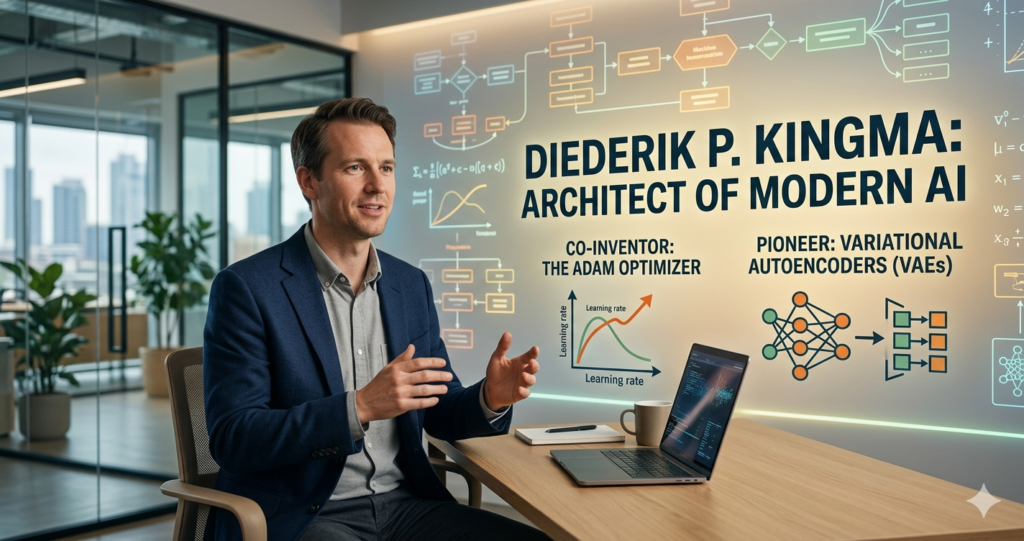
At the very top of that list is Diederik P. Kingma.
Whether you are a developer trying to optimize a model, a blogger curious about the tools you use daily, or an investor looking at the future of Silicon Valley, understanding Kingma’s work is essential. He isn’t just a researcher; he is the co-inventor of the frameworks that allow AI to learn efficiently. Today, we’re going to pull back the curtain on his contributions and explain why his work is the “secret sauce” inside the world’s most powerful AI models.
ALSO READ: Sam Altman 2026: The Masterplan for AGI and the $150B Fight for OpenAI’s Soul
Who is Diederik P. Kingma?
In the world of Machine Learning (ML), Diederik P. Kingma is a household name, often associated with his time at OpenAI and Google Brain (and more recently, Anthropic). If you’ve ever looked at a research paper in AI, you’ve likely seen his name cited thousands of times.
But let’s break that down into “human” terms. Imagine you’re trying to teach a child how to recognize a cat. You show them a thousand pictures. Now, imagine you have a way to make that child learn ten times faster, with fewer mistakes, and the ability to eventually draw a cat from scratch. That is essentially what Kingma did for computers.
He is best known for two massive pillars in AI:
- Variational Autoencoders (VAEs): A way for AI to generate new data.
- The Adam Optimizer: The “engine” that helps AI models learn by correcting their mistakes efficiently.
I remember back in 2014, when the “Auto-Encoding Variational Bayes” paper first dropped. At the time, we were struggling with models that were either too slow or too “stiff” to produce creative outputs. Kingma’s work changed the trajectory of the industry, moving us toward the “Generative AI” era we live in now.
The Adam Optimizer: The Engine Under the Hood
To understand why Diederik P. Kingma matters to your daily life, we have to talk about Adam. No, not a person—the algorithm.
In SEO, we optimize websites to rank higher. In AI, we “optimize” models to reduce errors. This process is called “stochastic gradient descent.” Before Kingma and his co-author Jimmy Ba introduced Adam (Adaptive Moment Estimation), training a large AI model was like trying to drive a car with a jerky steering wheel and no brakes.
How Adam Works (The Analogy)
Imagine you are standing at the top of a foggy mountain (the “Error”) and you want to get to the valley (the “Solution”).
- Old methods: You take steps of the same size, regardless of how steep the hill is. You might trip or overshoot the valley.
- The Adam Method: Adam looks at how fast you’ve been moving and how steep the ground is right now. It adjusts your speed automatically. It speeds up on long, smooth slopes and slows down when the terrain gets tricky.
Because of this efficiency, Adam became the default optimizer for almost every major AI project, from Google Translate to the recommendation engine on your Netflix account. When we talk about Kingma’s legacy, we are talking about the very fabric of how modern software “thinks.
Variational Autoencoders (VAEs) and Generative AI
If Adam is the engine, Variational Autoencoders (VAEs) are the imagination. Before we had the massive “Transformers” that power GPT-4, VAEs were the primary way researchers explored generative modeling.
Kingma’s work on VAEs allowed machines to take complex data—like thousands of human faces—and compress them into a “latent space” (a mathematical map). The AI could then pick a point on that map and “decode” it back into an image that looks like a human but has never actually existed.
Why This Matters for Content Creators
If you use AI image generators or even simple “Background Remover” tools, you are using descendants of the VAE logic. It’s the technology that taught AI that a “face” has two eyes, a nose, and a mouth, and that these things have a specific relationship to each other.
As someone who has managed websites for years, I’ve seen the shift from using stock photos to using AI-generated imagery. Without the foundational work of Diederik P. Kingma, the cost and speed of producing digital assets would still be stuck in 2010.
Practical Benefits: Why We Owe Him a Debt of Gratitude
You might be thinking, “This sounds very academic. How does it help me?” The reality is that Kingma’s research provides the bridge between “Math” and “Utility.”
1. Faster Innovation Cycles
Because the Adam optimizer is so reliable, developers don’t have to spend months “tuning” their AI. They can plug in the algorithm and get results. For us as consumers, this means better apps, more accurate voice assistants (like Siri and Alexa), and smarter search engines that actually understand what we’re looking for.
2. Democratization of AI
Before Kingma’s methods became standard, you needed a PhD and a supercomputer to train a decent model. Today, a college student can use a laptop and a library like PyTorch or TensorFlow—which both feature Adam prominently—to build something world-changing.
3. High-Fidelity Content
From noise-canceling headphones to deepfake detection and medical imaging, the ability to “reconstruct” data using VAEs has saved lives and made our digital experiences significantly more pleasant.
Step-by-Step: How to Use “Kingma’s Logic” in Your Work
Even if you aren’t a coder, you can apply the principles of Diederik P. Kingma’s work—specifically the “Adam” mindset of adaptive learning—to your SEO and blogging strategy.
Step 1: Establish a Baseline (The Input)
Just as a VAE starts with raw data, start your project with comprehensive research. Don’t just look at keywords; look at “Intent.” What is the “latent space” of your topic? What are the underlying needs your audience hasn’t voiced yet?
Step 2: Implement Adaptive Learning
In SEO, don’t just “set it and forget it.” Use the Adam approach:
- Monitor: Check your analytics weekly.
- Adjust: If a page is losing rank, “slow down” and analyze the content. If it’s gaining, “speed up” by adding more internal links and media.
Step 3: Iterate and Generate
Use the “Generative” mindset. Don’t just copy what works; use the patterns you’ve learned to create something new. Kingma’s VAEs don’t just repeat data; they create new variations. Your blog should do the same.
Recommended Tools for AI Enthusiasts
If you want to see the “Kingma Effect” in action, I recommend playing with these tools. Most of them utilize the optimization and generative principles he pioneered:
| Tool | Purpose | Connection to Kingma’s Work |
| PyTorch / TensorFlow | AI Development | These libraries use Adam as a core optimizer for training. |
| Hugging Face | Model Sharing | Contains thousands of VAE and Generative models. |
| Midjourney / DALL-E | Image Generation | Built on the evolution of VAEs and Diffusion models. |
| Google Colab | Cloud Coding | Allows you to run “Adam-optimized” code for free. |
My Professional Opinion: If you are a developer, always start with the Adam optimizer. It’s the “Goldilocks” of optimizers—not too slow, not too reckless. If you are a creator, focus on “Generative” tools that allow for fine-tuning, as this is where the industry is heading.
Common Mistakes to Avoid
In my decade of experience, I’ve seen people misinterpret the concepts introduced by researchers like Diederik P. Kingma. Here are the pitfalls:
- Over-reliance on Defaults: While Adam is great, it’s not a magic wand. Sometimes “learning” too fast leads to “overfitting” (where the AI memorizes the data instead of understanding it). In blogging, this is like “keyword stuffing”—you’re satisfying a metric, but losing the soul of the content.
- Ignoring the “Latent Space”: People often try to create AI content without understanding the underlying structure. If you don’t understand the why behind a topic, your “generative” output will be shallow.
- Complexity for Complexity’s Sake: Kingma’s papers are brilliant because they solve complex problems with elegant, simple math. Don’t make your business or your writing more complicated than it needs to be.
Conclusion
Diederik P. Kingma might not be a name you hear on the nightly news, but he is undoubtedly one of the architects of our digital future. From the way our phones recognize our faces to the way we generate professional articles and code, his fingerprints are everywhere.
By understanding the “Adam” optimizer and the power of Variational Autoencoders, we gain a deeper appreciation for the tools we use every day. We move from being passive users to informed participants in the AI revolution.
What’s your take? Have you noticed how much “smarter” AI has become in the last few years? Have you tried building anything with these tools? Drop a comment below—I’d love to hear your thoughts and help you navigate this exciting space!
FAQs About Diederik P. Kingma
1. What is Diederik P. Kingma most famous for?
He is most famous for co-authoring the paper on the Adam optimizer, which is the most widely used algorithm for training deep learning models, and for his groundbreaking work on Variational Autoencoders (VAEs).
2. Where does Diederik P. Kingma work now?
As of late 2024/2025, Kingma has moved from Google to Anthropic, the AI safety and research company behind the Claude LLM.
3. Did he work on ChatGPT?
While he didn’t “build” the chat interface, his work at OpenAI (where he was a founding member) provided the foundational optimization and generative techniques that made models like GPT-3 and GPT-4 possible.
4. Is the Adam optimizer still relevant?
Absolutely. Despite many newer optimizers being released, Adam remains the industry standard due to its balance of speed, stability, and ease of use.
5. Why are Variational Autoencoders (VAEs) important for SEOs?
While not directly related to ranking, VAEs are the tech that allows for high-quality image generation and data compression. Understanding them helps SEOs understand how search engines might “perceive” and “categorize” visual and textual data.
6. Where can I read his research?
Most of his work is published on arXiv.org. Look for “Auto-Encoding Variational Bayes” (2013) or “Adam: A Method for Stochastic Optimization” (2014) to see his most influential papers.

Elara Voss is a technology writer and immersive systems researcher at Argos.Vu, exploring the intersection of AI, virtual reality, and spatial computing. Her work focuses on how emerging technologies reshape the way we perceive, interact with, and understand information in the real world.
She writes about cutting-edge innovations, digital environments, and the future of human–technology interaction—translating complex ideas into engaging, forward-thinking insights.