
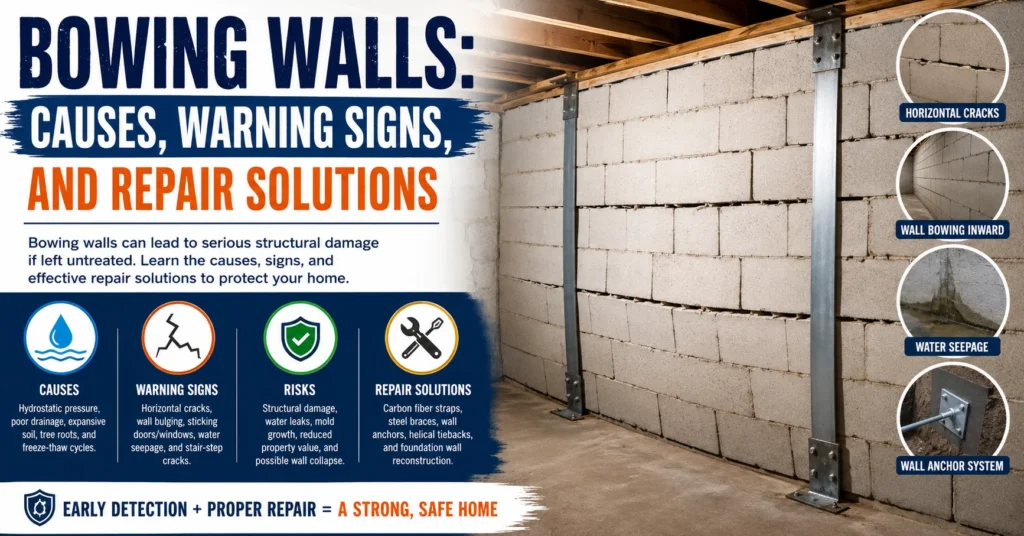
Your home’s foundation is responsible for supporting everything above it, making it one of the most important structural components of any property. When foundation walls begin to bend, lean, or curve inward, it is often a sign of a serious structural issue that should never be ignored. Bowing walls can develop gradually over several months or years, making the problem easy to overlook until visible damage becomes severe.
Fortunately, understanding what causes bowing walls, recognizing the warning signs early, and choosing the right repair solution can help homeowners prevent costly structural damage. Whether you have noticed horizontal cracks in your basement, walls that appear to bulge inward, or doors that suddenly no longer close properly, taking action quickly can protect your home’s safety and value.
This complete guide explains everything you need to know about bowing walls, including their common causes, warning signs, repair options, prevention strategies, and answers to the most frequently asked questions.
ALSO READ: Ikko Mind One: Complete Guide To The Smart AI Device
What Are Bowing Walls?
Bowing walls are foundation walls that have shifted inward due to excessive pressure from the surrounding soil. Instead of remaining straight and vertical, the wall begins to curve, lean, or bulge toward the inside of the basement or crawl space.
The problem most commonly affects basement walls made from:
- Poured concrete
- Concrete block (CMU)
- Brick masonry
- Stone foundations
Although minor movement may appear harmless initially, continued pressure can cause the wall to weaken over time, increasing the risk of structural failure if left untreated.
Why Bowing Walls Are A Serious Problem
Foundation walls are designed to resist vertical loads from the house above them. However, they are not designed to withstand excessive sideways pressure.
When enough lateral force builds up, the wall begins to move inward.
Ignoring bowing walls can lead to:
- Large structural cracks
- Water leaks
- Basement flooding
- Mold growth
- Reduced property value
- Expensive foundation replacement
- Complete wall collapse in severe cases
The earlier the problem is identified, the easier and less expensive it usually is to repair.
Common Causes Of Bowing Walls
Understanding why bowing walls occur helps homeowners prevent future damage.
Hydrostatic Pressure
Hydrostatic pressure is the most common cause of bowing basement walls.
After heavy rainfall or snowmelt, water saturates the soil around the foundation. Wet soil becomes significantly heavier and pushes against the basement wall with tremendous force.
As pressure increases over time, the wall gradually bends inward.
Expansive Clay Soil
Certain soil types absorb large amounts of water.
Clay soil expands when wet and shrinks when dry.
This continuous cycle creates repeated pressure on the foundation, eventually causing walls to bow.
Poor Drainage Around the Home
Improper drainage allows water to collect around the foundation.
Common drainage issues include:
- Clogged gutters
- Short downspouts
- Poor yard grading
- Standing water
- Broken drainage pipes
The more water surrounding the home, the greater the pressure placed against foundation walls.
Freeze-Thaw Cycles
In colder climates, soil freezes during winter and expands.
As temperatures rise, the soil contracts again.
These repeated freeze-thaw cycles create constant movement that stresses basement walls over many years.
Tree Roots
Large trees planted too close to the home can contribute to foundation movement.
Roots may:
- Shift surrounding soil
- Remove moisture unevenly
- Increase soil movement
Although tree roots are rarely the primary cause, they can worsen existing foundation problems.
Poor Construction Practices
Sometimes the problem begins during construction.
Potential issues include:
- Weak foundation design
- Thin foundation walls
- Poor-quality concrete
- Inadequate reinforcement
- Improper backfilling
Construction defects may not become obvious until years after the home is built.
Aging Foundations
Every building experiences some settling over time.
As materials age, they naturally lose some strength, making older homes more vulnerable to foundation movement.
Warning Signs Of Bowing Walls
Recognizing the early symptoms can prevent major structural repairs.
Horizontal Cracks
Horizontal cracks are among the strongest indicators of bowing walls.
These cracks usually appear near the center of basement walls where pressure is greatest.
Walls Leaning Inward
Stand at one end of the basement and look along the wall.
If the wall appears curved or tilted inward, foundation movement may already be occurring.
Stair-Step Cracks
Concrete block foundations often develop stair-step cracks along mortar joints.
These cracks frequently indicate structural shifting.
Bulging Walls
Instead of leaning evenly, some walls bulge in the middle while remaining attached near the top and bottom.
This usually indicates increasing soil pressure.
Water Seepage
Cracks created by wall movement allow groundwater to enter the basement.
Signs include:
- Damp walls
- Wet floors
- Water stains
- Efflorescence
- Mold growth
Doors and Windows Sticking
Foundation movement can shift the entire house slightly.
This often causes:
- Doors sticking
- Windows becoming difficult to open
- Uneven door frames
Floor Cracks
Concrete basement floors may crack as the foundation shifts.
Although floor cracks alone don’t always indicate bowing walls, they often accompany foundation movement.
How Bowing Walls Are Diagnosed
Foundation specialists typically inspect several factors before recommending repairs.
The inspection often includes:
- Measuring wall deflection
- Examining crack patterns
- Checking soil conditions
- Inspecting drainage systems
- Evaluating wall materials
- Looking for water intrusion
Laser measurements may be used to determine how far the wall has moved.
Repair Solutions For Bowing Walls
Different repair methods are used depending on the severity of the damage.
Carbon Fiber Straps
Carbon fiber reinforcement is ideal for walls with minor movement.
Benefits include:
- Extremely strong
- Thin profile
- No excavation required
- Quick installation
- Prevents further movement
However, carbon fiber cannot straighten walls that have already bowed significantly.
Steel Wall Braces
Steel braces are installed vertically against the inside of the basement wall.
Advantages include:
- Strong reinforcement
- Stops additional movement
- Long-lasting solution
- Suitable for moderate damage
Some systems allow gradual wall straightening over time.
Wall Anchors
Wall anchors connect the bowing wall to stable soil outside the foundation.
This method can:
- Stop movement
- Pull walls back toward their original position
- Improve structural stability
Wall anchors require excavation in the yard for installation.
Helical Tiebacks
Helical anchors are screwed deep into stable soil beyond the pressure zone.
These anchors stabilize severely bowed walls and are commonly used when limited yard space prevents traditional wall anchor installation.
Foundation Wall Reconstruction
If the wall has experienced extreme structural failure, replacement may be necessary.
This process includes:
- Excavating around the home
- Removing the damaged wall
- Building a new reinforced foundation wall
- Installing waterproofing and drainage systems
Although this is the most expensive repair, it is sometimes the safest solution.
Can Bowing Walls Be Prevented?
Many cases of foundation damage can be prevented with proper maintenance.
Improve Drainage
Direct rainwater away from the house by:
- Cleaning gutters regularly
- Extending downspouts
- Maintaining proper yard grading
Waterproof the Foundation
Exterior waterproof membranes and drainage systems reduce hydrostatic pressure significantly.
Avoid Overwatering
Excessive watering near the home’s foundation increases soil pressure.
Keep irrigation systems directed away from foundation walls.
Plant Trees Carefully
Large trees should be planted a safe distance from the foundation to reduce soil movement.
Monitor Basement Walls
Inspect your basement several times each year.
Look for:
- New cracks
- Moisture
- Wall movement
- Water stains
Early detection often saves thousands of dollars.
When Should You Call A Foundation Professional?
Contact a professional immediately if you notice:
- Horizontal cracks
- Walls leaning inward
- Cracks wider than 1/4 inch
- Water entering the basement
- Large wall bulges
- Rapid crack growth
Waiting too long usually increases repair costs.
Cost Of Repairing Bowing Walls
Repair costs vary depending on the severity of damage and repair method.
Typical factors affecting cost include:
- Wall size
- Amount of movement
- Foundation material
- Soil conditions
- Drainage improvements
- Local labor costs
Minor reinforcement projects are generally much less expensive than complete wall replacement.
Obtaining multiple professional inspections can help homeowners compare repair recommendations and costs.
Are Bowing Walls Covered By Homeowners Insurance?
Coverage depends on the cause of the damage.
Many standard homeowners insurance policies do not cover foundation movement caused by:
- Soil expansion
- Hydrostatic pressure
- Poor drainage
- Normal settling
However, sudden damage resulting from covered events may qualify under certain policies.
Review your insurance policy carefully or speak with your provider to understand your specific coverage.
How Long Do Repairs Last?
Modern foundation repair systems are designed to provide long-term structural support.
When installed correctly and combined with proper drainage improvements, many repair systems can last for decades.
Routine maintenance and periodic inspections help ensure the repairs continue performing effectively over time.
Conclusion
Bowing walls are one of the clearest signs that a home’s foundation is under excessive stress. While the problem usually develops slowly, ignoring it can lead to serious structural damage, costly repairs, and even safety hazards.
Fortunately, early detection makes a significant difference. Watching for warning signs such as horizontal cracks, inward wall movement, and basement moisture allows homeowners to address problems before they become severe. Whether the solution involves carbon fiber straps, steel braces, wall anchors, or full wall reconstruction, choosing the appropriate repair method can restore structural stability and protect your investment.
Regular inspections, proper drainage, and proactive maintenance remain the best defenses against foundation problems. By taking action early, homeowners can preserve both the safety and long-term value of their property.
FAQs
What is bowing walls?
Bowing walls are foundation walls that bend or lean inward because of excessive pressure from surrounding soil, water, or structural movement.
Can bowing walls be repaired without replacing the foundation?
Yes. Many bowing walls can be stabilized using carbon fiber straps, steel braces, or wall anchor systems without replacing the entire foundation.
Are horizontal cracks always a sign of bowing walls?
Horizontal cracks are one of the strongest warning signs of bowing walls and should be inspected by a foundation professional as soon as possible.
How quickly do bowing walls get worse?
The rate varies depending on soil conditions, moisture levels, and structural pressure. Some walls move slowly over several years, while others deteriorate much faster.
Can poor drainage cause bowing walls?
Yes. Poor drainage allows water to accumulate around the foundation, increasing hydrostatic pressure that can eventually cause basement walls to bow inward.
ALSO READ: How To Read A Climbing Route For Better Performance

Elara Voss is a technology writer and immersive systems researcher at Argos.Vu, exploring the intersection of AI, virtual reality, and spatial computing. Her work focuses on how emerging technologies reshape the way we perceive, interact with, and understand information in the real world.
She writes about cutting-edge innovations, digital environments, and the future of human–technology interaction—translating complex ideas into engaging, forward-thinking insights.