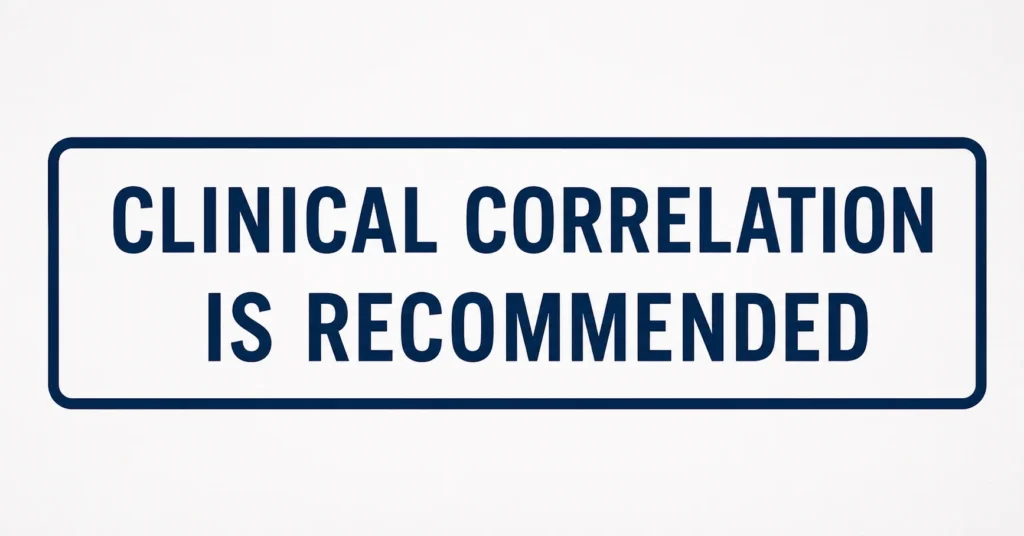
Have you ever opened a medical report and noticed the phrase Clinical Correlation Is Recommended? If so, you’re not alone. Many people see these words on radiology reports, pathology results, MRI scans, CT scans, X-rays, or laboratory tests and immediately worry that something is seriously wrong. Fortunately, that’s usually not the case.
In reality, this phrase is one of the most common statements used by healthcare professionals. It does not automatically indicate a serious illness or confirm a diagnosis. Instead, it reminds your healthcare provider to compare the test findings with your symptoms, medical history, physical examination, and any additional tests before making a final diagnosis.
Understanding what this phrase means can help reduce unnecessary anxiety and give you a clearer picture of how doctors interpret medical reports. In this guide, we’ll explain what Clinical Correlation Is Recommended means, why doctors use it, when it appears on reports, and what you should do if you see it.
ALSO READ: Carbon Tint vs Ceramic: Which Window Tint Is Better?
What Does Clinical Correlation Is Recommended?
The phrase Clinical Correlation Is Recommended simply means that the test results should be interpreted alongside your overall clinical condition.
Medical imaging and laboratory tests provide valuable information, but they rarely tell the whole story. Doctors combine multiple pieces of information before deciding what a finding actually means.
Clinical Correlation Is Recommended includes considering:
- Your current symptoms
- Your medical history
- Your age
- Your physical examination
- Previous medical records
- Blood test results
- Other imaging studies
- Risk factors and lifestyle
Only after reviewing all these details can your healthcare provider determine whether a finding is important or simply an incidental observation.
Why Do Doctors Use This Phrase?
Doctors and radiologists include this statement because medical tests have limitations.
For example, an MRI may show a small abnormality that is completely unrelated to your symptoms. Likewise, an X-ray might appear normal even though a patient is experiencing significant pain.
Rather than making assumptions, the reporting physician leaves the final interpretation to the doctor treating the patient, who has access to the complete clinical picture.
This approach helps prevent:
- Misdiagnosis
- Unnecessary treatments
- Unneeded surgeries
- Incorrect conclusions
- Missed medical conditions
In other words, Clinical Correlation Is Recommended improves accuracy.
Clinical Correlation Is Recommended Is Not A Diagnosis
One of the biggest misunderstandings is believing that this phrase confirms a disease.
It doesn’t.
Instead, it means the findings require interpretation.
For example:
A report might say:
Small disc bulge at L4-L5. Clinical Correlation Is Recommended.
This does not mean the disc bulge is causing pain.
Many healthy adults have small disc bulges without experiencing any symptoms.
If a patient has:
- Lower back pain
- Leg numbness
- Sciatica
- Muscle weakness
the disc bulge may explain those symptoms.
If the patient has none of these symptoms, the finding may simply be an age-related change that requires no treatment.
This is exactly why Clinical Correlation Is Recommended matters.
Where Does This Phrase Commonly Appear?
You may find clinical correlation is recommended in many different types of medical reports.
MRI Reports
MRI scans frequently identify:
- Mild arthritis
- Disc degeneration
- Tendon injuries
- Ligament tears
- Brain abnormalities
Some findings may be significant, while others are harmless. Clinical Correlation Is Recommended helps determine the difference.
CT Scan Reports
CT scans may detect:
- Lung nodules
- Kidney cysts
- Liver lesions
- Enlarged lymph nodes
- Sinus inflammation
Some findings need follow-up, while others require no treatment.
X-Ray Reports
X-rays commonly mention:
- Mild arthritis
- Bone spurs
- Old fractures
- Soft tissue swelling
- Degenerative changes
These findings may or may not explain a patient’s symptoms.
Ultrasound Reports
Ultrasounds often reveal:
- Ovarian cysts
- Gallstones
- Fatty liver
- Kidney cysts
- Thyroid nodules
Many of these are common incidental findings.
Pathology Reports
After a biopsy, a pathologist may recommend clinical correlation if laboratory findings should be compared with:
- Patient history
- Physical examination
- Additional laboratory testing
Blood Test Results
Even laboratory reports sometimes include this recommendation.
An abnormal blood value doesn’t always indicate disease.
For example:
- Slightly elevated liver enzymes
- Mild anemia
- Borderline cholesterol
- Elevated inflammatory markers
These results must always be interpreted within the patient’s overall health.
What Is Clinical Correlation?
Clinical correlation is the process of connecting medical test findings with everything known about the patient.
Rather than relying on one report alone, doctors ask questions like:
- What symptoms does the patient have?
- When did the symptoms begin?
- Are they getting worse?
- Does the imaging explain those symptoms?
- Could another condition be responsible?
- Are additional tests necessary?
This process ensures that patients receive accurate diagnoses instead of treatment based solely on imaging findings.
Why Test Results Alone Aren’t Enough
Modern medical technology is incredibly advanced, but no test is perfect.
Imaging studies often reveal abnormalities in healthy people.
For example:
Research has shown that many adults without back pain have MRI findings such as:
- Bulging discs
- Disc degeneration
- Mild spinal arthritis
Similarly:
- Healthy people may have thyroid nodules.
- Small kidney cysts are common with aging.
- Mild sinus inflammation often appears on CT scans without causing symptoms.
If doctors treated every abnormal finding, many patients would undergo unnecessary procedures.
Clinical correlation prevents overtreatment.
Examples Of Clinical Correlation
Knee MRI
MRI finding:
Mild meniscus degeneration. Clinical correlation is recommended.
If the patient has:
- Knee pain
- Locking
- Swelling
the MRI finding may explain the symptoms.
If the patient has no pain, treatment may not be necessary.
Chest CT
CT finding:
Small pulmonary nodule. Clinical correlation recommended.
The doctor considers:
- Smoking history
- Family history
- Patient age
- Previous scans
- Symptoms
These factors determine whether follow-up imaging is needed.
Brain MRI
MRI finding:
Small nonspecific white matter changes. Clinical correlation advised.
These changes might relate to:
- Aging
- Migraine headaches
- High blood pressure
- Diabetes
- Multiple sclerosis
- Previous infections
Without symptoms, the finding may not indicate serious disease.
Does This Phrase Mean Something Is Serious?
Usually, no.
The phrase is considered standard medical language.
Doctors use it every day because medicine involves much more than interpreting images or laboratory numbers.
Sometimes the finding turns out to be important.
Other times, it is completely harmless.
That is why your doctor reviews everything together before making recommendations.
ALSO READ: Brake Warning Light Is On: Causes And Quick Fixes

Elara Voss is a technology writer and immersive systems researcher at Argos.Vu, exploring the intersection of AI, virtual reality, and spatial computing. Her work focuses on how emerging technologies reshape the way we perceive, interact with, and understand information in the real world.
She writes about cutting-edge innovations, digital environments, and the future of human–technology interaction—translating complex ideas into engaging, forward-thinking insights.