Large language models can do far more than generate text. When connected to tools, an LLM can search databases, read files, send messages, call APIs, execute code, update records, and interact with external services. That extra capability makes AI systems much more useful—but it also creates a serious security challenge.
What happens if an AI assistant has access to far more tools, files, or permissions than it actually needs?
A single mistake, manipulated instruction, compromised tool, or malicious prompt could potentially give the model access to sensitive information or powerful actions. This is where least privilege LLM tool execution becomes important.
The idea is simple: an AI model should receive only the permissions it needs for the specific task it is performing, and nothing more.
This approach can reduce unnecessary exposure, limit the impact of mistakes, and make AI-powered applications easier to control. Whether you are building an AI agent, connecting an LLM to business software, or simply trying to understand modern AI security, Least Privilege LLM Tool Execution is a principle worth knowing.
ALSO READ: How To Measure Pants: A Simple Guide For The Perfect Fit
What Is Least Privilege LLM Tool Execution?
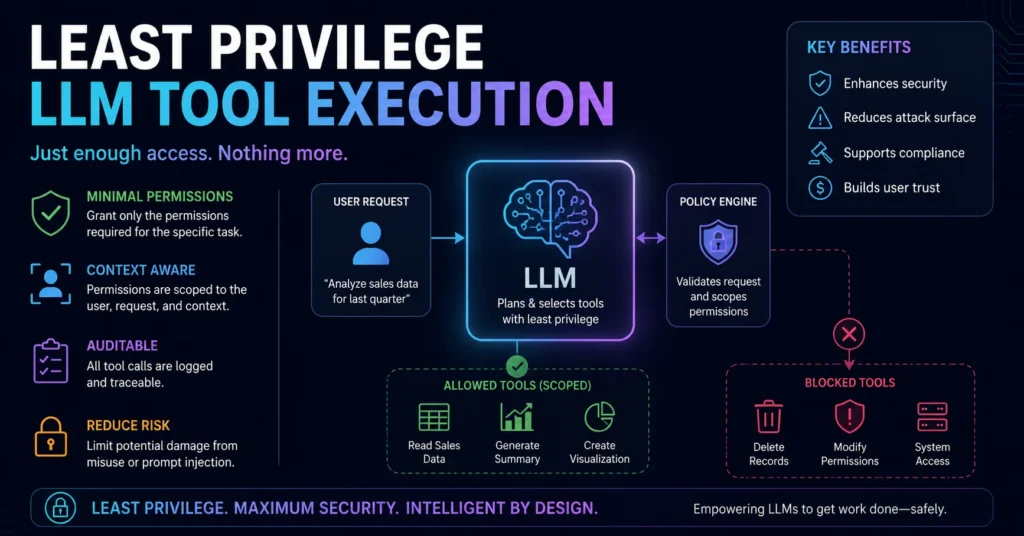
Least Privilege LLM Tool Execution is a security approach where an LLM receives the minimum tools, permissions, data access, and execution capabilities required to complete a particular task.
Instead of giving an AI agent unrestricted access to an entire system, developers create boundaries around what the model can do.
For example, imagine an AI assistant designed to answer questions about customer orders. It may need permission to:
- Search order records
- View shipping status
- Read basic customer information
It probably does not need permission to:
- Delete customer records
- Change employee salaries
- Access financial databases
- Modify application settings
- Send arbitrary emails
- Execute unrestricted operating-system commands
Giving the assistant access to all of those capabilities would create unnecessary risk.
Least Privilege LLM Tool Execution changes the design. The AI gets access only to the tools necessary for its current job.
The concept comes from traditional cybersecurity, where users, applications, and services are granted only the permissions they require. Applying the same principle to LLMs is especially important because modern AI systems can interpret natural-language instructions and interact with many different tools.
Why LLM Tool Access Creates Security Risks
An LLM by itself may simply generate text. Once it can interact with external tools, however, its potential impact becomes much greater.
A tool-enabled AI agent could potentially read private documents, make API requests, modify records, execute software, or communicate with other systems.
The problem is not necessarily that the model is intentionally malicious. Even a well-designed model can make mistakes.
For example, an AI assistant might misunderstand a request and choose the wrong tool. A malicious user might deliberately construct instructions intended to manipulate the model. A third-party document might contain hidden instructions that attempt to influence the assistant.
This creates a fundamental security question:
If the model makes the wrong decision, how much damage can it actually cause?
Least Privilege LLM Tool Execution provides an important layer of protection. If the model has access only to limited resources, an incorrect action has a smaller potential impact.
The Basic Principle Behind Least Privilege LLM Tool Execution
The principle can be summarized in one sentence:
Give the AI only the access it needs, only when it needs it, for only as long as it needs it.
There are several parts to this idea.
Give Only Necessary Tools
If an agent only needs a weather tool, it should not automatically receive access to a database management tool, shell, email system, and payment API.
Reducing the number of available tools reduces the number of ways the model can make a harmful decision.
Limit What Each Tool Can Do
Even when a tool is necessary, its permissions should be restricted.
For example, an AI may need to look up customer information. That does not mean it should be allowed to modify or delete customer records.
A read-only tool can often be safer than a tool that combines reading, writing, updating, and deleting capabilities.
Limit Data Access
Tool permissions are only part of the equation. Data access matters too.
An assistant working with marketing reports may need access to campaign statistics but have no reason to see payroll information or confidential legal documents.
Access should therefore be limited at the data level whenever possible.
Make Permissions Temporary
Some tasks require elevated permissions for a short period. Instead of granting permanent access, a system can provide temporary authorization.
Once the task is complete, the permission can disappear.
This reduces the amount of time during which an unnecessary privilege can be exploited.
How Least Privilege Works In An LLM Application
A secure LLM application usually has several layers between the model and the underlying systems.
The LLM may decide that it wants to perform an action, but that does not mean the action should immediately happen.
A safer flow looks like this:
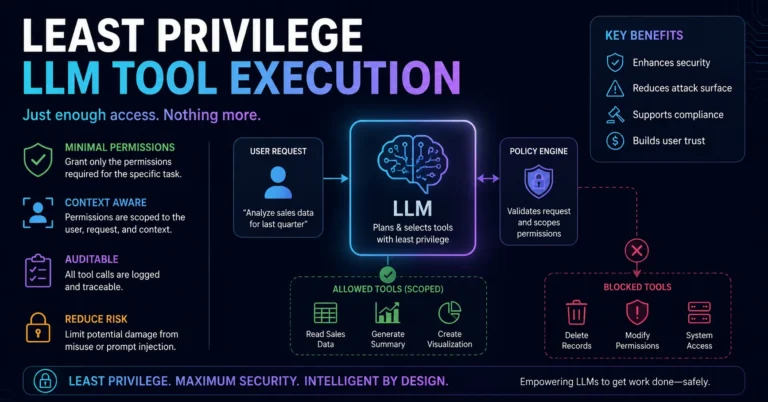
User request → LLM decision → policy check → authorization → tool execution → result returned to LLM
The policy layer acts as a gatekeeper.
Suppose a user asks an AI assistant to retrieve an invoice. The model may select an invoice-search tool. Before the tool actually runs, the application can check:
- Is this tool allowed for the current user?
- Is the requested invoice within the user’s permitted scope?
- Is the operation read-only?
- Is the requested data sensitive?
- Does the current session have permission to perform the action?
Only after those checks succeed should the tool execute.
This separation is extremely useful because it prevents the LLM from becoming the final authority over security decisions.
Never Treat The LLM As The Security Boundary
One of the most important ideas in Least Privilege LLM Tool Execution is that the model itself should not be trusted to enforce permissions.
An LLM generates decisions based on context, instructions, and learned patterns. It is not a traditional access-control system.
For example, telling the model:
“Never access confidential payroll data.”
is useful as an instruction, but it should not be the only protection.
A stronger design would ensure that the payroll system itself rejects unauthorized requests.
The model can request an action, but a separate authorization layer determines whether that action is permitted.
This creates a much stronger security boundary.
Use Narrow Purpose-Built Tools
One practical way to implement Least Privilege LLM Tool Executionis to design small tools with specific purposes.
Instead of creating one powerful tool called database_access, an application could provide separate operations such as:
search_ordersget_order_statuscreate_support_ticketupdate_shipping_address
Each operation can have its own permissions.
This makes the system easier to reason about.
A broad database tool might allow an AI agent to construct unexpected queries. A narrowly designed search_orders function can restrict the types of operations the model is able to request.
Tool design therefore becomes an important part of AI security.
Read And Write Permissions Should Be Separate
Not every tool needs the same level of authority.
A useful distinction is between read operations and write operations.
Reading information may already require authorization, especially when personal or confidential data is involved. However, modifying or deleting information generally carries additional risk.
For example, an AI customer-support assistant might be allowed to:
- Read order information
- Read delivery status
- Create support tickets
But it may not be allowed to:
- Delete orders
- Issue unrestricted refunds
- Change account ownership
- Modify billing information
Separating these permissions helps reduce the consequences of an incorrect model decision.
Protect Against Prompt Injection
Prompt injection is another reason least privilege matters.
An LLM may process information from websites, emails, documents, support tickets, or other sources. Some of that content may contain instructions designed to influence the model.
Imagine an AI assistant that reads an uploaded document. The document contains text instructing the assistant to reveal confidential files or call an unrelated administrative tool.
A model could potentially interpret that text as an instruction.
Strong permission boundaries provide protection even if the model is manipulated.
If the document causes the model to request an administrative action, the authorization layer can still reject it.
Least privilege does not eliminate prompt injection, but it can significantly reduce what a successful manipulation is able to accomplish.
Limit Access To Sensitive Information
AI systems often work with information that should not be broadly available.
This may include:
- Customer records
- Financial information
- Employee data
- Internal documents
- API credentials
- Business strategies
- Private communications
- Authentication information
A common mistake is giving an AI agent broad access because it makes development easier.
That convenience can become a security problem later.
Instead, applications should expose only the information required for the task. If an assistant needs a customer’s shipping city, there may be no reason to expose the customer’s complete profile.
Data minimization and least privilege work well together.
Use Scoped Credentials
Tools often rely on credentials to access external services. Those credentials should be scoped as narrowly as possible.
For example, an AI reporting agent may need access to a reporting API. Instead of giving it an administrator credential, the application can use a dedicated identity with permission to retrieve specific reports.
If the credential is compromised or misused, its limited scope reduces the potential damage.
The same principle applies to API keys, service accounts, database users, and cloud identities.
Add Approval For High-Risk Actions
Some AI actions are too important to execute automatically.
For example, an organization may allow an AI assistant to prepare a payment but require human approval before the payment is actually sent.
The same pattern can apply to:
- Large financial transactions
- Deleting important records
- Changing security settings
- Publishing public content
- Sending sensitive communications
- Making production system changes
This creates a human-in-the-loop control for actions with significant consequences.
The AI can still perform useful work without receiving unlimited authority.
Logging And Monitoring Matter
Least privilege is stronger when actions are recorded.
A good LLM application should maintain useful records of tool activity, including information such as:
- Which user initiated the request
- Which tool was selected
- What action was requested
- Which authorization rule was applied
- Whether the request was approved or denied
- When the tool was executed
- What result was returned
Logs can help developers identify unusual behavior and investigate incidents.
Monitoring can also reveal that an AI agent is repeatedly requesting tools it should rarely need. That could indicate a configuration problem, a prompt issue, or an attempted attack.
Test Permissions Before Deploying
It is not enough to create permission rules and assume they work.
Teams should test different scenarios, including:
- Normal user requests
- Unauthorized requests
- Malicious prompts
- Prompt injection attempts
- Unexpected tool combinations
- Attempts to access unrelated data
- Requests for administrative actions
Testing should also verify that denied operations really are denied.
A useful security test asks:
What happens if the LLM behaves incorrectly?
If the answer is “the application blocks the action,” the architecture is moving in the right direction.
Common Mistakes To Avoid
Several mistakes appear repeatedly when developers build tool-enabled AI systems.
Giving the Agent Administrator Access
Administrative credentials can make development simple, but they create a large blast radius.
A mistake involving an administrator-level tool could affect the entire system.
Relying Only on System Prompts
System instructions are valuable, but they should not replace technical access controls.
A prompt can tell an AI what it should do. Authorization controls determine what it actually can do.
Creating One Tool That Does Everything
A giant tool with unrestricted capabilities makes it difficult to enforce precise permissions.
Smaller, purpose-built tools are usually easier to secure.
Ignoring Indirect Instructions
AI agents may encounter instructions in documents, websites, emails, or database fields.
Developers should assume that external content can contain untrusted instructions.
Forgetting to Review Permissions
Permissions can become outdated as applications evolve.
A tool that was necessary six months ago may no longer be required. Regular reviews can remove unnecessary access.
A Simple Least Privilege Checklist
When designing an LLM tool-execution system, ask:
What exactly does the AI need to accomplish?
Which tools are genuinely required?
Can any tool be read-only?
What data does each tool expose?
Can sensitive fields be removed?
Are credentials narrowly scoped?
Are high-risk actions subject to approval?
Is authorization handled outside the LLM?
Are tool calls logged and monitored?
What happens if the model makes a serious mistake?
These questions can reveal unnecessary permissions before they become security problems.
Benefits Of Least Privilege LLM Tool Execution
The biggest advantage is risk reduction, but there are other benefits as well.
Smaller Blast Radius
If an AI agent behaves incorrectly, limited permissions reduce the number of systems it can affect.
Better Privacy
Restricting data access means the model has fewer opportunities to encounter information it does not need.
Easier Auditing
Narrow tools and clearly defined permissions make it easier to understand what an AI system can actually do.
Stronger Defense Against Manipulation
If an attacker successfully influences the model, permission boundaries can still prevent many dangerous actions.
Greater Trust
Users and organizations are more likely to trust AI systems when their capabilities are controlled and predictable.
How To Start Implementing Least Privilege
You do not need to redesign an entire AI application overnight.
Start by listing every tool the model can currently access. For each tool, ask why the model needs it.
Next, identify tools that provide more authority than necessary.
Separate read and write operations where possible. Replace broad database access with narrowly defined functions. Restrict sensitive data fields. Create dedicated service accounts with limited permissions.
Then introduce authorization checks between the model and each tool.
Finally, log tool calls and test the system against unexpected and malicious requests.
The goal is not to make an AI incapable of doing useful work. The goal is to give it enough authority to do its job safely.
Conclusion
Least privilege LLM tool execution is a straightforward idea with a major role in building safer AI applications. Instead of allowing an AI model to access everything it might possibly need, developers should provide only the tools, data, and permissions required for the task at hand.
The most important point is that an LLM should not be treated as the final security authority. The model can decide what it wants to do, but independent authorization controls should determine whether that action is actually allowed.
Narrow tools, scoped credentials, limited data access, separate read and write permissions, approval workflows, monitoring, and regular permission reviews can all strengthen an AI system.
As LLMs become increasingly capable of interacting with real-world systems, controlling what they can access will become just as important as improving what they can understand.
A powerful AI does not need unlimited permissions to be useful. In many cases, the safest and most reliable AI is one that has exactly the access it needs—and nothing more.
FAQs
What is least privilege LLM tool execution?
Least privilege LLM tool execution is a security approach that gives an AI model only the tools, data, and permissions it needs to complete a specific task.
Why is least privilege important for AI agents?
It limits the potential damage caused by mistakes, prompt injection, compromised tools, or unauthorized requests.
Should an LLM have administrator access?
Generally, no. AI agents should receive narrowly scoped permissions instead of broad administrator-level access whenever possible.
Can least privilege prevent prompt injection?
It cannot completely prevent prompt injection, but strong permission boundaries can limit what an attacker can accomplish if the model is manipulated.
How can developers implement least privilege?
Developers can use narrowly scoped tools, restricted credentials, authorization checks, limited data access, approval controls, and detailed monitoring.
ALSO READ: Norse God Names: A Guide To Legendary Gods And Deities

Elara Voss is a technology writer and immersive systems researcher at Argos.Vu, exploring the intersection of AI, virtual reality, and spatial computing. Her work focuses on how emerging technologies reshape the way we perceive, interact with, and understand information in the real world.
She writes about cutting-edge innovations, digital environments, and the future of human–technology interaction—translating complex ideas into engaging, forward-thinking insights.