Imagine standing on a quiet beach. Above the waves, the world feels calm. Beneath the surface, however, the ocean is alive with sound. Fish communicate, dolphins whistle, whales sing across hundreds of miles, and ships create low-frequency vibrations that travel through the water. Unlike on land, where sight often dominates, sound is one of the most important ways marine life interacts with its environment.
This is where underwater sound maker technology becomes incredibly important. These specialized devices are designed to create, transmit, or simulate sound beneath the water’s surface for a variety of purposes. Scientists use them to study marine life, naval organizations rely on them for communication and detection, and engineers use them to test underwater equipment. Even recreational divers and filmmakers benefit from advancements in underwater acoustic technology.
you’ll discover how underwater sound makers work, the different types available, their real-world applications, advantages, challenges, and what the future holds for this fascinating technology.
ALSO READ: The Beauty Of Orthodox Arabic Icons Explained
What Is An Underwater Sound Maker?
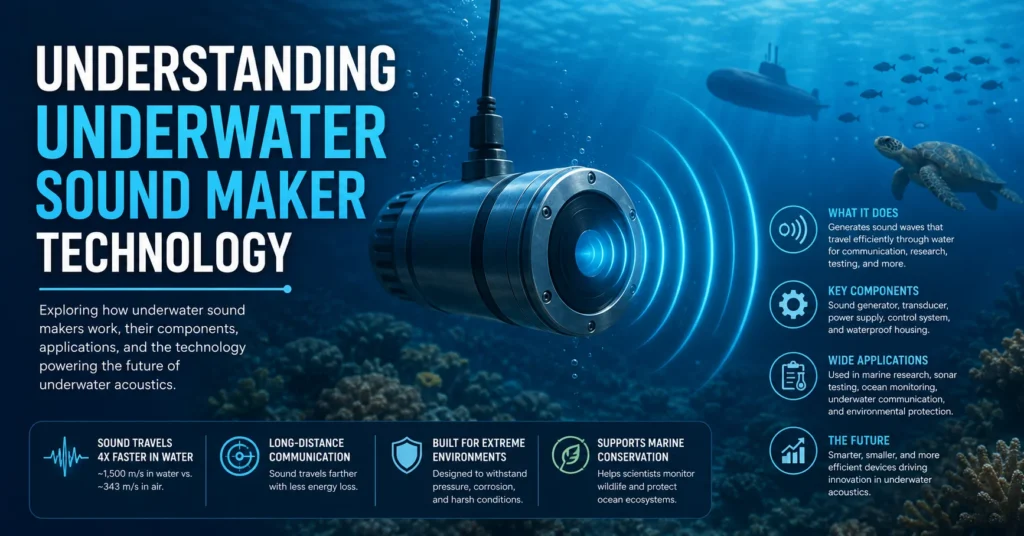
An underwater sound maker is a device specifically designed to generate sound waves that travel efficiently through water. Unlike traditional speakers that work in air, these devices are engineered to overcome the unique physical properties of water.
Water is much denser than air, allowing sound to travel approximately four times faster—around 1,500 meters per second, compared to about 343 meters per second in air. Because of this, underwater sound makers require specialized materials and components capable of producing clear acoustic signals without being damaged by pressure, moisture, or corrosion.
Depending on their purpose, these devices can generate:
- Continuous tones
- Pulsed signals
- Broadband noise
- Frequency sweeps
- Recorded sounds
- Digital communication signals
Each type of sound serves a specific purpose, from attracting marine animals for research to testing sonar systems.
Why Sound Matters Underwater
Light behaves very differently underwater. As depth increases, sunlight fades quickly, making vision less effective.
Sound, on the other hand, can travel long distances with relatively little loss of energy. This makes it the primary method for communication and navigation beneath the surface.
Marine animals have evolved to depend heavily on sound for:
- Finding food
- Avoiding predators
- Locating mates
- Navigating long distances
- Staying connected with groups
Humans have learned from nature by developing underwater acoustic technologies that perform many similar tasks.
How Underwater Sound Maker Technology Works
Although designs vary, most underwater sound makers operate using the same basic principles.
Electrical Energy Becomes Sound
The process begins with an electrical signal generated by a controller or electronic circuit.
This signal is sent to a transducer, which converts electrical energy into mechanical vibrations.
Those vibrations create pressure waves that move through the surrounding water as sound.
The Role of Piezoelectric Transducers
Many underwater sound makers use piezoelectric materials.
These unique materials change shape when electricity is applied. The rapid expansion and contraction produce vibrations that generate sound waves.
Piezoelectric transducers are popular because they offer:
- High efficiency
- Excellent durability
- Wide frequency range
- Reliable underwater performance
They are commonly found in scientific instruments, sonar systems, and underwater communication devices.
Frequency Selection
Different underwater applications require different frequencies.
Generally:
- Low frequencies travel farther.
- High frequencies provide greater detail but shorter range.
For example:
- Whale communication studies often use lower frequencies.
- Imaging sonar systems rely on much higher frequencies.
- Scientific testing may use multiple frequencies depending on research goals.
Selecting the right frequency is one of the most important aspects of underwater sound maker design.
Main Components Of An Underwater Sound Maker
Most systems include several essential parts working together.
Sound Generator
This creates the electrical signal that determines the sound’s characteristics.
It controls:
- Frequency
- Duration
- Pulse intervals
- Signal strength
Power Supply
Depending on the application, power may come from:
- Rechargeable batteries
- External power cables
- Solar-supported systems
- Large research vessel power systems
Portable underwater sound makers usually rely on battery packs designed for extended operation.
Acoustic Transducer
The transducer converts electrical signals into underwater sound waves.
Its size and design largely determine:
- Maximum output
- Frequency range
- Sound quality
- Operating depth
Waterproof Housing
Since electronics cannot be exposed to seawater, every underwater sound maker includes a waterproof enclosure.
Manufacturers commonly use:
- Stainless steel
- Titanium
- Marine-grade aluminum
- High-strength engineering plastics
These materials resist corrosion while protecting internal electronics.
Control System
Modern underwater sound makers often include programmable controllers that allow users to customize:
- Signal timing
- Frequency patterns
- Volume levels
- Automatic scheduling
Some advanced systems can even be operated remotely.
Different Types Of Underwater Sound Makers
Not all underwater sound makers serve the same purpose.
Here are the most common categories.
Scientific Research Devices
Marine researchers use underwater sound makers to:
- Study fish behavior
- Monitor whale migration
- Test underwater sensors
- Conduct acoustic experiments
These systems often generate highly controlled sound patterns for accurate scientific analysis.
Sonar Signal Generators
Sonar testing requires precise sound generation.
These underwater sound makers help engineers:
- Calibrate sonar equipment
- Measure system performance
- Test underwater detection capabilities
They play a vital role in both civilian and military applications.
Underwater Communication Devices
Divers, remotely operated vehicles (ROVs), and autonomous underwater vehicles (AUVs) cannot rely on radio waves because they travel poorly through water.
Instead, underwater sound makers transmit acoustic communication signals that carry information over considerable distances.
Marine Animal Deterrent Systems
Some underwater sound makers are designed to keep marine animals away from dangerous areas.
Examples include:
- Construction zones
- Offshore wind farms
- Fishing operations
- Ship maintenance areas
These systems aim to reduce accidental harm while protecting wildlife.
Educational Demonstration Systems
Universities and marine science centers often use underwater sound makers to demonstrate acoustic principles during classroom or laboratory activities.
These systems help students understand underwater physics through practical experiments.
Common Applications
The versatility of underwater sound maker technology makes it valuable across many industries.
Oceanographic Research
Researchers use underwater sound makers to better understand ocean conditions.
Applications include:
- Water temperature studies
- Current measurements
- Acoustic mapping
- Marine ecosystem monitoring
Marine Biology
Scientists studying marine animals frequently use acoustic equipment.
They can:
- Track migration routes
- Observe communication behavior
- Monitor breeding activity
- Study habitat usage
Responsible use helps researchers gather important information while minimizing disturbance.
Naval Operations
Defense organizations rely heavily on underwater acoustics.
Applications include:
- Sonar testing
- Communication
- Equipment evaluation
- Training exercises
Reliable underwater sound generation is essential for accurate performance.
Offshore Engineering
Companies involved in offshore construction use underwater sound makers during:
- Pipeline installation
- Platform inspections
- Equipment testing
- Structural monitoring
Acoustic testing improves operational safety.
Environmental Monitoring
Environmental agencies monitor underwater ecosystems using acoustic technology.
They study:
- Fish populations
- Noise pollution
- Coral reef activity
- Habitat health
The data supports conservation efforts worldwide.
Benefits Of Underwater Sound Maker Technology
Modern underwater sound makers offer numerous advantages.
Long-Distance Communication
Sound travels much farther underwater than many other forms of communication.
This makes acoustic systems ideal for deep-sea operations.
High Reliability
Well-designed underwater sound makers continue functioning under:
- High pressure
- Cold temperatures
- Saltwater exposure
- Extended deployments
This reliability is essential for research missions lasting weeks or months.
Improved Scientific Understanding
Acoustic technology has transformed marine science.
Researchers now gather detailed information that would have been nearly impossible to obtain only a few decades ago.
Supports Marine Conservation
Acoustic monitoring helps scientists detect environmental changes earlier, allowing conservation efforts to respond more effectively.
Versatile Applications
One technology supports many different fields, including:
- Research
- Defense
- Education
- Environmental protection
- Offshore industries
Its flexibility continues to drive innovation.
Challenges And Limitations
Despite its advantages, underwater sound maker technology faces several obstacles.
Background Noise
The ocean is naturally noisy.
Common sources include:
- Waves
- Rain
- Ships
- Marine animals
- Geological activity
These sounds can interfere with acoustic signals.
Signal Distortion
Water conditions constantly change.
Temperature, salinity, and pressure affect how sound travels, making accurate signal transmission more challenging.
Environmental Concerns
Excessive underwater noise can affect marine life.
Researchers and engineers increasingly focus on designing quieter systems and using sound responsibly to reduce environmental impacts.
Equipment Costs
High-quality underwater acoustic systems often require specialized materials and precision manufacturing.
This makes professional equipment relatively expensive.
Recent Advances In Underwater Sound Maker Technology
Technology continues evolving rapidly.
Several innovations are improving performance.
Smarter Digital Processing
Advanced processors now produce cleaner, more accurate signals while reducing unwanted noise.
This improves communication and research quality.
Smaller Devices
Modern electronics allow manufacturers to build compact underwater sound makers without sacrificing performance.
Portable systems are becoming increasingly common.
Longer Battery Life
Energy-efficient electronics extend operating times, allowing research equipment to remain deployed for months.
AI-Assisted Signal Analysis
Artificial intelligence helps researchers identify marine species by analyzing underwater sounds automatically.
This significantly reduces manual processing time.
Improved Materials
New waterproof composites and corrosion-resistant metals increase equipment lifespan in harsh marine environments.
Choosing The Right Underwater Sound Maker
Selecting the right device depends on your intended application.
Consider these factors before making a decision.
Frequency Range
Choose a system designed for the frequencies required by your project.
Different tasks demand different acoustic characteristics.
Operating Depth
Not every device is suitable for deep-water environments.
Always verify the maximum depth rating.
Power Requirements
Portable battery-powered units work well for field research, while permanent installations may require external power.
Durability
Marine environments are extremely demanding.
Look for corrosion-resistant materials and dependable waterproof sealing.
Ease of Control
Modern programmable systems provide greater flexibility through adjustable settings and automated operation.
The Future Of Underwater Sound Maker Technology
The future looks promising.
Researchers are developing systems that are:
- More energy efficient
- Smaller and lighter
- Smarter through artificial intelligence
- More environmentally friendly
- Better integrated with underwater robots
As exploration of the oceans continues, underwater sound makers will become even more important in scientific discovery, environmental monitoring, and underwater communication.
Emerging technologies may eventually allow autonomous underwater vehicles to communicate more naturally while collecting enormous amounts of ocean data with minimal human intervention.
Best Practices For Responsible Use
Because underwater sound can influence marine ecosystems, responsible operation is essential.
Users should:
- Select only the necessary sound levels.
- Avoid unnecessary continuous transmissions.
- Follow environmental regulations.
- Monitor potential impacts on marine wildlife.
- Maintain equipment regularly for efficient performance.
Responsible practices help balance technological progress with ocean conservation.
Conclusion
An underwater sound maker is much more than a device that produces noise beneath the water’s surface. It is a sophisticated piece of acoustic technology that supports scientific research, underwater communication, environmental monitoring, engineering, and marine conservation. By converting electrical energy into carefully controlled sound waves, these systems allow humans to explore and better understand one of the most challenging environments on Earth.
As technology continues to advance, underwater sound makers are becoming more compact, energy efficient, and intelligent. These improvements will enable researchers, engineers, and marine professionals to gather more accurate data while reducing environmental impact. Understanding how these devices work not only highlights the remarkable science behind underwater acoustics but also emphasizes their growing importance in protecting and exploring our oceans for generations to come.
FAQs
What is an underwater sound maker?
An underwater sound maker is a specialized device that generates sound waves beneath the water’s surface for communication, research, sonar testing, navigation, and other underwater applications.
How does an underwater sound maker produce sound?
It converts electrical energy into mechanical vibrations using an acoustic transducer, which creates sound waves that travel efficiently through water.
Where are underwater sound makers commonly used?
They are widely used in marine research, underwater communication, naval operations, offshore engineering, environmental monitoring, and educational studies.
Why is sound more effective than light underwater?
Sound travels much farther and faster through water than light, making it the preferred method for communication, navigation, and detection in underwater environments.
Are underwater sound makers safe for marine life?
When used responsibly and within environmental guidelines, underwater sound makers can support research and conservation while minimizing impacts on marine ecosystems.
ALSO READ: Do Curly Hair Conditioners Work For Every Curl Type?

Elara Voss is a technology writer and immersive systems researcher at Argos.Vu, exploring the intersection of AI, virtual reality, and spatial computing. Her work focuses on how emerging technologies reshape the way we perceive, interact with, and understand information in the real world.
She writes about cutting-edge innovations, digital environments, and the future of human–technology interaction—translating complex ideas into engaging, forward-thinking insights.