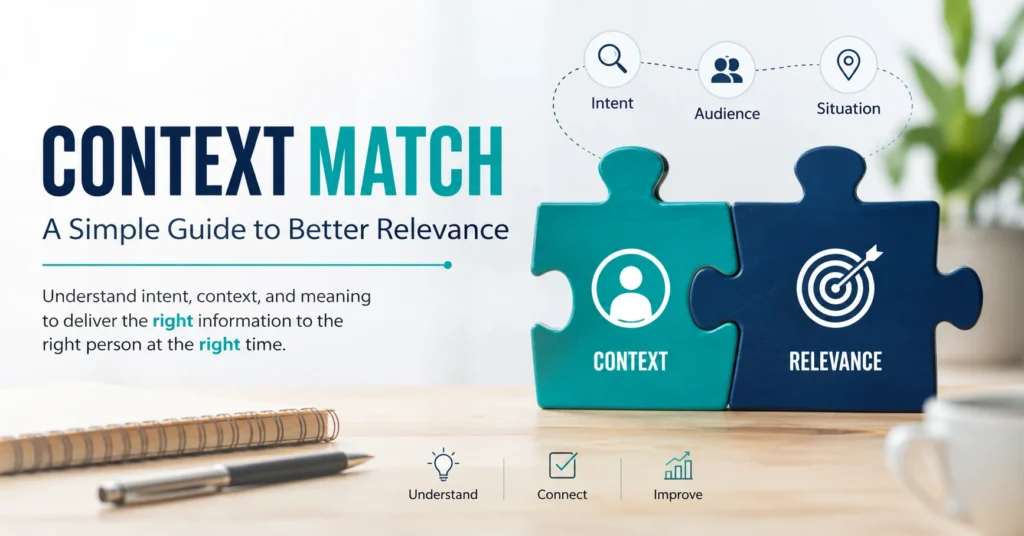
Have you ever searched for something online, asked an AI tool a question, or opened a recommendation that seemed technically correct but somehow missed the point? The answer may contain the right words, yet it does not feel useful. That gap is where context match becomes important.
Context match is about how well information, content, a search result, recommendation, or response fits the situation surrounding a specific request. Instead of looking only at individual words, it considers meaning, intent, relationships, circumstances, and what the user is actually trying to accomplish.
This idea has become increasingly important as people interact with search engines, recommendation systems, websites, chatbots, and AI-powered tools. Modern users do not simply want information. They want information that makes sense for them, at that moment, in that situation.
For example, someone searching for “jaguar” might be interested in an animal, a car, or a sports team. Matching the exact keyword is not enough. Understanding the surrounding context makes the result much more relevant.
A strong context match can improve search experiences, content quality, personalization, customer communication, and even everyday decision-making. In this simple guide, we will explore what context match means, why it matters, how it works, common mistakes to avoid, and practical ways to create more relevant experiences.
ALSO READ: Apptage.com AI First Product: What You Need To Know
What Is Context Match?
Context match refers to the degree to which a piece of information matches the meaning, purpose, and circumstances of a particular situation.
In simple terms, it answers a basic question:
Does this information actually fit what the person needs right now?
A traditional keyword match may identify the same words between a query and a piece of content. A context match goes further by considering what those words mean within a larger situation.
Imagine someone searches for:
Best laptop for college students.
A basic system might return pages containing the words “best,” “laptop,” and “college students.” A more context-aware system may consider factors such as portability, battery life, budget, durability, software requirements, and whether the student needs the computer for writing, design, programming, or gaming.
The second approach is more useful because it understands the likely purpose behind the search.
Context can include several elements:
- User intent
- Previous interactions
- Location or environment
- Time and circumstances
- Related topics
- Audience needs
- Language and terminology
- The specific problem being solved
- The relationship between different pieces of information
The goal is not simply to find a match. The goal is to find the right match.
Why Context Match Matters
Relevance is one of the biggest factors that determines whether information is useful. People are surrounded by content every day, but more information does not automatically mean better information.
When content lacks context, users may have to spend extra time filtering irrelevant results. This creates frustration and can make even accurate information feel unhelpful.
A strong context match improves the experience in several ways.
It Saves Time
When information closely matches the user’s situation, there is less need to search through unrelated material.
For example, a person looking for beginner photography advice does not necessarily need an advanced technical discussion about professional studio lighting. Both topics are related to photography, but they serve different needs.
Context helps separate those needs.
It Improves Understanding
Information becomes easier to understand when it is presented at the right level and in the right situation.
A beginner usually benefits from definitions, examples, and straightforward explanations. An experienced professional may prefer technical details, comparisons, and advanced recommendations.
The subject can remain the same while the appropriate context changes.
It Creates Better User Experiences
Websites, applications, search platforms, and AI systems can become more helpful when they understand what users are trying to accomplish.
Instead of showing generic information, they can provide responses that feel more relevant and timely.
It Supports Better Decisions
Relevant information helps people make more informed choices. Whether someone is comparing products, researching a topic, learning a skill, or solving a problem, context reduces unnecessary information and highlights what matters.
Context Match vs. Keyword Match
Keyword matching and context matching are related, but they are not the same thing.
Keyword matching focuses primarily on specific terms. If a search contains the word “running shoes,” a keyword-based approach may prioritize pages that contain those exact words.
Context matching considers the broader meaning.
Suppose a user searches:
“Running shoes for flat feet.”
A page simply discussing popular running shoes may contain the keyword “running shoes,” but it does not necessarily satisfy the user’s specific need.
A stronger context match would focus on factors relevant to the stated situation, such as support, comfort, fit, cushioning, and other considerations associated with the user’s request.
This distinction is especially important for modern search and AI systems. Users increasingly ask complete questions rather than entering short collections of keywords.
Compare these examples:
Keyword-focused:
“coffee machine”
Context-rich:
“Which coffee machine is easiest to clean for someone who makes coffee every morning?”
The second query provides considerably more information about intent.
A useful way to think about it is:
Keyword match asks, “Do these words appear?”
Context match asks, “Does this information make sense here?”
The Main Elements Of A Strong Context Match
Context matching can involve many signals, but several elements are particularly important.
User Intent
Intent is often the most important part of relevance.
A person may search for information because they want to learn, compare, purchase, troubleshoot, plan, or simply understand something.
For example, the query “best office chair” could indicate buying intent. Meanwhile, “how does an ergonomic chair work?” suggests informational intent.
The same general subject can require completely different content.
Understanding intent helps ensure that the response matches the user’s actual goal.
Surrounding Information
Words rarely exist in isolation.
Consider the term “apple.” Without context, it could refer to a fruit or a technology company.
Additional words change the meaning:
- “apple pie recipe”
- “Apple laptop”
- “apple nutrition”
- “Apple software update”
The surrounding information provides the clues needed to determine which meaning is appropriate.
Previous Interaction
In some digital experiences, earlier interactions can provide useful context.
If someone has already explained that they are a beginner, future answers can be written at an introductory level. If they have previously selected a particular category, recommendations can potentially be adjusted accordingly.
However, personalization should be relevant rather than intrusive. More context is not always better if it does not contribute meaningfully to the current request.
Timing
Context can change over time.
A recommendation that made sense last year may no longer be suitable today. A seasonal question may have different answers depending on the time of year.
Timing is therefore another important part of relevance, particularly for news, trends, prices, schedules, and rapidly changing information.
Audience
The same information may need to be presented differently depending on who will read it.
A technical explanation for an engineer can use specialized terminology. A beginner-friendly article should explain those terms instead of assuming prior knowledge.
Matching the audience is an essential part of matching the context.
How Context Match Works In Search
Search has evolved considerably beyond simply looking for exact words.
Modern search systems attempt to understand the meaning behind queries and connect them with relevant information.
For example, someone might search:
Why is my phone battery dying so quickly?
They may not be looking for a general article about batteries. Their intent is likely troubleshooting.
A relevant result might discuss background applications, battery health, screen brightness, network conditions, software issues, or other possible causes.
The strongest result is therefore not necessarily the page containing the most mentions of “phone battery.” It is the page that best addresses the user’s underlying problem.
This is one reason natural, useful content tends to be more valuable than content created solely around repeated keywords.
Context Match And AI
Context has become especially important with AI systems because users often communicate with AI conversationally.
Instead of entering short search phrases, people may write detailed requests that include preferences, limitations, goals, and previous information.
For example:
“I need a simple dinner idea for four people. I have 30 minutes, limited ingredients, and I don’t want anything spicy.”
This request contains multiple contextual signals:
- Number of people
- Available time
- Ingredient limitations
- Taste preference
- Desired outcome
A useful response needs to account for all of them.
If the response ignores the time limit or recommends a spicy recipe, it may technically answer the question but still fail the context match.
This demonstrates an important principle:
Accuracy without context is not always relevance.
Context Match In Content Creation
Context matching is also valuable for bloggers, publishers, marketers, and website owners.
Creating content around a keyword is not enough. A successful article should understand why someone is searching for that keyword and what information they expect to find.
For example, a person searching for “how to choose a desk” may want practical buying advice. A person searching for “desk dimensions” may want measurements. A person searching for “small desk ideas” may be looking for space-saving inspiration.
All three searches relate to desks, but their contexts are different.
Good content should therefore focus on the searcher’s problem rather than simply repeating the target phrase.
Write for the Question Behind the Keyword
Before creating an article, ask:
- What does the reader really want to know?
- What problem are they trying to solve?
- What might they ask next?
- What level of knowledge do they have?
- What information would help them take action?
These questions can reveal the context surrounding a topic.
Use Related Concepts Naturally
Relevant content should cover the concepts readers reasonably expect to encounter.
If you are writing about choosing a laptop, for example, relevant concepts may include performance, battery life, screen quality, portability, storage, operating system, and budget.
These topics should appear naturally because they help answer the reader’s question—not simply because they are related keywords.
Match the Reader Level
Avoid making every article unnecessarily complicated.
A beginner-friendly guide should define unfamiliar terms and use practical examples. An advanced article can assume greater knowledge and explore technical details.
Matching the reader’s knowledge level makes content much more effective.
Common Context Match Mistakes
Even well-written content can lose relevance when context is overlooked.
Focusing Too Much on Exact Keywords
Repeating a keyword does not automatically make content relevant.
A page can mention the same phrase dozens of times while providing very little useful information.
Searchers care about whether their problem is solved, not how frequently a phrase appears.
Ignoring Search Intent
One of the most common mistakes is producing the wrong type of content for a query.
Someone looking for instructions needs actionable steps. Someone comparing options needs clear differences. Someone seeking a definition needs a concise explanation before additional details.
The format should support the intent.
Providing Generic Answers
Generic information may be technically correct but still fail to satisfy the user.
For example, if someone asks how to improve a slow website, a generic explanation of websites is not particularly helpful. The answer should address likely causes and practical solutions.
Adding Irrelevant Information
More information is not always better.
Unrelated details can make an article longer without making it more useful. Strong content knows what to include and what to leave out.
Assuming Too Much
The opposite problem also occurs when writers assume that readers already understand complicated concepts.
A good context match balances simplicity with depth.
How To Improve Context Match
Improving relevance does not require complicated technology. It starts with understanding the situation behind the request.
Identify the Main Goal
Start by determining what the user wants to accomplish.
Is the goal to learn, solve, compare, choose, create, purchase, or understand?
Once the goal is clear, it becomes easier to determine what information belongs in the response.
Identify Important Constraints
Look for limitations that could affect the answer.
These might include:
- Budget
- Time
- Skill level
- Location
- Available resources
- Personal preferences
- Technical requirements
- Intended audience
Ignoring an important constraint can quickly turn a relevant answer into an irrelevant one.
Consider the Surrounding Topic
Look beyond the main phrase.
What other concepts are connected to the question? What terminology might clarify its meaning? What related concerns would naturally matter to someone asking this question?
This creates a more complete understanding of the context.
Prioritize Useful Information
Once the context is clear, prioritize information based on usefulness.
Put the most relevant answers first. Follow them with supporting explanations, examples, and additional details.
This makes the content easier to scan and more satisfying to read.
Remove Unnecessary Material
After writing, review the content and ask whether every section supports the main purpose.
If a paragraph does not help the reader understand the topic or move toward their goal, consider removing or rewriting it.
This simple editing step can dramatically improve relevance.
Context Match And User Experience
A strong context match can make digital experiences feel more natural.
Imagine visiting a website and immediately finding information that addresses your specific question. The experience feels efficient.
Now imagine seeing several pages that technically contain your keywords but require extensive searching to find the answer. The experience feels frustrating.
This difference is important because people often judge the quality of a service based on how quickly it helps them accomplish something.
Relevance creates confidence.
When users consistently receive information that fits their needs, they are more likely to trust the platform, return to it, and engage with its content.
Context Match In Recommendations
Recommendations are another area where context matters greatly.
A movie recommendation should consider more than a person’s general interest in movies. Genre preferences, mood, viewing habits, age suitability, previous choices, and the situation in which they are watching can all affect relevance.
The same principle applies to products, articles, music, educational resources, and other recommendations.
A recommendation becomes more useful when it answers:
“Why is this appropriate for this particular person or situation?”
That does not mean every recommendation needs to be heavily personalized. It simply means that relevance should be based on meaningful signals rather than superficial similarities.
Why Better Relevance Matters For Businesses
Businesses can also benefit from stronger context matching.
A customer who receives information tailored to their actual problem is more likely to understand the product or service.
For example, someone researching software for a small team may care about ease of use, pricing, setup time, and collaboration. A large enterprise buyer may care more about security, scalability, administration, and integrations.
Treating both customers exactly the same can lead to poor communication.
Context allows businesses to present the information that matters most to different audiences without losing the core message.
A Simple Context Match Framework
A practical framework can make this concept easier to apply.
Think about five questions:
Who?
Who is asking or reading?
What?
What information are they requesting?
Why?
Why do they need it?
When?
What timing or circumstances affect the request?
What next?
What will they likely do with the information?
Answering these questions can reveal much more than a keyword alone.
For example, a person searching for “website security” could be a beginner learning the basics, a business owner protecting a small site, or a developer troubleshooting a technical issue.
The phrase is the same, but the appropriate response changes dramatically depending on the context.
How To Measure Relevance
Context match can be evaluated by looking at outcomes rather than simply counting keywords.
Useful signals may include:
- Whether users find the information they need
- Time spent finding an answer
- Engagement with relevant content
- Repeat visits
- Search refinement behavior
- Customer satisfaction
- Conversion or completion rates
- Whether users continue asking the same question
For content creators, another useful test is simple:
If someone reads this page, will they feel that their original question was actually answered?
If the answer is no, the content probably needs stronger contextual relevance.
The Future Of Context Match
As digital systems become more capable, context is likely to become increasingly important.
People are already moving toward more conversational interactions with search engines, AI assistants, websites, and applications. These interactions contain more information than traditional short keyword searches.
That creates an opportunity for better experiences.
Systems that understand intent, relationships, preferences, and circumstances can potentially provide information that feels more useful and natural.
At the same time, there is an important balance to maintain. Context should be used responsibly. Personalization should have a clear purpose, and users should not feel that irrelevant personal information is being used simply because it is available.
The best contextual experiences are helpful without becoming intrusive.
Practical Examples Of Context Match
Consider a few everyday examples.
A student searches for “study schedule.” A relevant response might consider class hours, available study time, deadlines, and breaks.
A traveler searches for “things to do in a city.” A useful result could reflect trip length, interests, budget, and season.
A business owner searches for “email marketing.” Their needs may depend on company size, audience, goals, and technical experience.
A beginner searches for “photography camera.” A helpful guide should explain important features without overwhelming them with professional terminology.
In each case, the main keyword is only the starting point. The surrounding context determines what information is actually useful.
Final Thoughts
Context match is ultimately about one simple idea: relevance should be measured by meaning, not just matching words.
Whether you are creating content, improving a website, designing an AI system, building search functionality, or simply answering someone’s question, understanding the situation behind a request can make a huge difference.
The strongest responses consider intent, audience, circumstances, related information, and practical goals. They provide enough detail to be useful without filling the experience with unnecessary material.
For content creators, this means writing for real people and their questions rather than focusing exclusively on keywords. For businesses, it means communicating according to customer needs. For digital systems, it means moving beyond surface-level matching toward a deeper understanding of relevance.
A good context match makes information feel like it belongs exactly where it appears.
And in a world filled with endless information, that kind of relevance is incredibly valuable.
FAQs
What is context match?
Context match is the process of making information, content, or responses relevant to the specific situation, intent, audience, and needs surrounding a request.
Why is context match important?
It helps people find useful information faster, improves user experiences, and makes answers more accurate and meaningful.
How is context match different from keyword matching?
Keyword matching focuses mainly on shared words, while context match considers meaning, intent, circumstances, and the relationship between different pieces of information.
Can context match improve SEO?
Yes. Creating content that genuinely satisfies search intent and covers relevant concepts can improve usefulness, readability, and overall search relevance.
How can writers improve context match?
Writers can improve it by identifying the reader’s intent, understanding their knowledge level, considering constraints, answering the main question clearly, and removing irrelevant information.
ALSO READ: AP South East: A Simple Guide To What It Means

Elara Voss is a technology writer and immersive systems researcher at Argos.Vu, exploring the intersection of AI, virtual reality, and spatial computing. Her work focuses on how emerging technologies reshape the way we perceive, interact with, and understand information in the real world.
She writes about cutting-edge innovations, digital environments, and the future of human–technology interaction—translating complex ideas into engaging, forward-thinking insights.