When you come across the term dynamic shared object, it can sound far more complicated than it really is. The phrase is commonly used in software development, operating systems, and computer programming, especially when talking about files that contain reusable code.
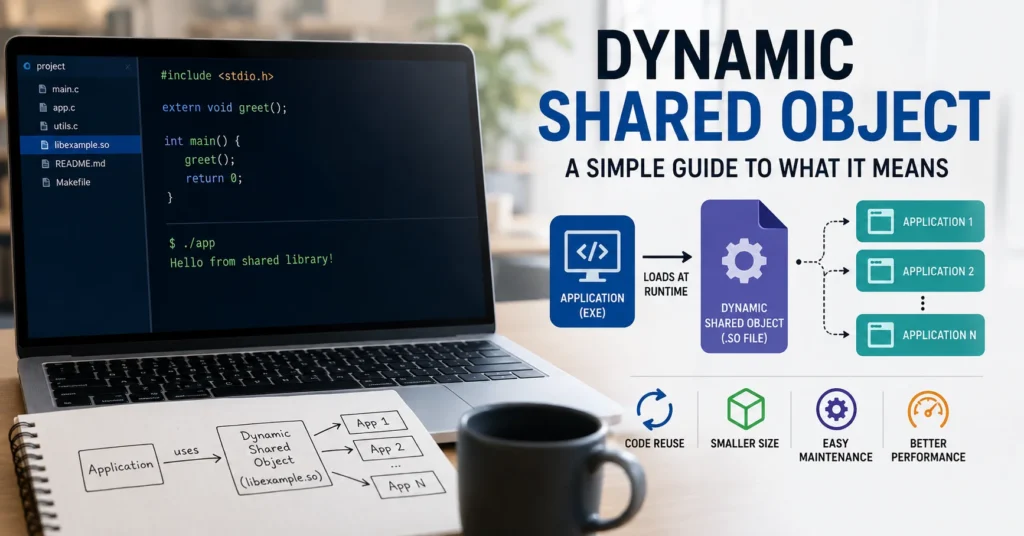
In simple terms, a dynamic shared object is a file that stores compiled code that different programs can use when they need it. Instead of placing the same code inside every application, developers can keep commonly needed functions in one shared file. Programs can then load those functions while they are running.
This approach can make software smaller, easier to maintain, and more efficient. It also allows developers to update certain parts of a system without rebuilding every application that uses them.
But how does it actually work? What does a dynamic shared object look like? Why are these files important, and how are they different from ordinary program files?
ALSO READ: Context Match: A Simple Guide To Better Relevance
What Is A Dynamic Shared Object?
A dynamic shared object, often abbreviated as DSO, is a compiled binary file containing code and sometimes data that can be shared by multiple programs.
The word “dynamic” refers to the fact that the code does not necessarily have to be permanently included in an application when the application is built. Instead, the operating system can load the required shared object into memory when the program starts or when the code is needed.
The word “shared” means that several programs can use the same copy of the code. This avoids unnecessary duplication.
On Linux and other Unix-like systems, dynamic shared objects commonly use the .so file extension. The name stands for “shared object.”
For example, a file might look like:
libexample.so
A program can use functions stored inside that file rather than keeping its own separate copy of those functions.
This concept is especially useful for large operating systems and software applications that rely on many common libraries.
How Does A Dynamic Shared Object Work?
To understand a dynamic shared object, imagine a toolbox.
Instead of every worker carrying a complete toolbox containing every possible tool, a group of workers can access a shared workshop. When someone needs a particular tool, they use it from the shared collection.
A DSO works in a similar way.
A developer may create a library containing functions such as:
- File-handling functions
- Mathematical operations
- Network communication
- Image processing
- Database operations
- Security functions
- User-interface components
An application can then use those functions without having to contain all of the underlying code itself.
During the build process, the application is typically linked against the shared library. When the application runs, the operating system’s dynamic linker or loader helps locate the required shared object and makes its functions available to the program.
This process happens behind the scenes in most cases, so ordinary users may never notice it.
Why Are Dynamic Shared Objects Important?
Dynamic shared objects solve several practical problems in software development.
One of the biggest advantages is code reuse. If several applications need the same functionality, developers do not have to write or package the same code repeatedly.
For example, suppose ten different applications need a particular mathematical library. Without shared code, each application could contain its own copy.
With a shared object, all ten applications can potentially use the same library.
This can reduce duplication and make software easier to maintain.
Another important advantage is that shared libraries can sometimes be updated independently of the applications that use them. If a bug is fixed inside a compatible shared library, multiple programs may benefit from the update without each program being rebuilt.
That said, library updates must be handled carefully because compatibility problems can occur.
Dynamic Shared Object vs. Static Library
One of the easiest ways to understand a dynamic shared object is to compare it with a static library.
A static library contains compiled code that is incorporated into a program during the linking stage. Once the application is built, the required library code becomes part of the resulting executable.
A dynamic shared object works differently.
Instead of copying the library code directly into every application, the application can refer to the shared library and use it when running.
This creates an important difference in how applications are packaged.
With static linking:
- Library code becomes part of the executable.
- The executable may become larger.
- Different applications can contain duplicate copies of the same library code.
- Updating the library generally requires rebuilding applications.
With dynamic linking:
- The shared library remains a separate file.
- Multiple applications can use the same library.
- Executables can be smaller.
- Compatible library updates may benefit multiple applications.
Neither approach is automatically better in every situation. Developers choose between them based on portability, performance, compatibility, deployment requirements, and other technical considerations.
What Is Inside A Dynamic Shared Object?
A DSO is not simply a text file containing source code.
It is usually a compiled binary containing information required by the operating system and applications.
Depending on how it was created, a shared object may contain:
- Machine code
- Read-only data
- Writable data
- Exported symbols
- Relocation information
- Debugging information
- Metadata
- Dependency information
The machine code represents instructions that the processor can execute.
Symbols help programs and tools identify functions and variables contained within the library.
Relocation information can help the loader adjust addresses when the shared object is placed into memory.
This is one reason DSOs can appear mysterious when viewed as ordinary files. They are designed for computers and development tools rather than for humans to read directly.
What Does The Extension Mean?
On many Linux and Unix-like systems, shared object files use the .so extension.
For example:
libmath.so
The “so” generally refers to “shared object.”
You may also encounter versioned names such as:
libmath.so.1
or:
libmath.so.1.2
Version numbers can help systems manage different releases of a library.
A program may expect a particular compatible version of a shared object. The exact naming and versioning approach can vary depending on the operating system, distribution, and library.
This is why simply replacing a shared library file with another version can sometimes cause unexpected problems.
What Is Dynamic Linking?
Dynamic linking is the process that connects an application with shared libraries.
There are two broad ideas worth understanding: loading a library when a program starts and loading one during execution when it is specifically needed.
In the first case, the program declares dependencies on particular shared libraries. When the application starts, the dynamic loader looks for those libraries and prepares them for use.
In the second case, an application can deliberately load a shared object while it is already running.
This can be useful for software that supports optional features or plugins.
For example, an image-editing application might not need every available image format loaded at startup. It could load a specific module when a user opens a particular type of image.
This can make applications more flexible and modular.
Dynamic Shared Objects And Memory Usage
One of the major benefits of shared libraries is the potential reduction in duplicated memory.
Imagine several applications using the same library. The operating system may be able to map the same read-only portions of that library into the memory spaces of multiple processes.
This does not mean every part of the library is always physically shared in every situation. Memory behavior depends on the operating system, architecture, library design, and how the code is used.
Still, shared libraries provide an important mechanism for avoiding unnecessary duplication.
This is particularly valuable on systems running many applications at the same time.
Dynamic Shared Objects And Software Updates
Another reason developers use DSOs is easier maintenance.
Suppose a shared library contains a security fix. If the applications using that library are compatible with the updated version, updating the library can potentially improve the security of multiple programs.
This is one of the practical strengths of shared libraries.
However, software compatibility matters.
A new library version might change behavior, remove a function, alter an interface, or introduce another incompatibility. If an application expects something different, it may fail to start or behave incorrectly.
For this reason, software developers pay close attention to application programming interfaces and binary compatibility when creating shared libraries.
What Are Dependencies?
A dependency is something a program needs in order to work properly.
A dynamic shared object can itself depend on other shared libraries.
For example, an application might depend on Library A, while Library A depends on Library B.
This creates a chain of dependencies.
When the application starts, the dynamic loader may need to locate not just the main library but also the other libraries required by it.
If a required library cannot be found, the program may display an error and fail to launch.
This is why dependency management is an important part of maintaining Linux and Unix-like systems.
Common Problems With Dynamic Shared Objects
Although shared libraries offer many advantages, they can also create problems.
One common issue is a missing shared library.
A program may expect a particular .so file, but the file may not be installed or may not be located where the system expects it.
Another problem is an incompatible version.
A library may exist, but it may not provide the functions or interface expected by the application.
Incorrect library paths can also cause trouble.
If the system cannot find a required library in its configured search locations, the application may fail even though the file exists somewhere on the computer.
These problems are often described as dependency or library-loading errors.
How Developers Troubleshoot DSO Problems
When a program fails because of a shared object, developers typically start by identifying which library is missing or causing the problem.
They may inspect the application’s dependencies and examine the symbols required by the program.
On Linux systems, several command-line tools can help with this process.
For example, tools commonly used by developers include utilities for examining:
- Shared library dependencies
- Binary file information
- Exported symbols
- Runtime library paths
- ELF file structures
The exact tool depends on the problem being investigated.
The key idea is to avoid randomly replacing library files. A better approach is to identify the dependency problem first and then determine the correct compatible solution.
Dynamic Shared Objects In Linux
The concept of a dynamic shared object is especially important in Linux.
Many Linux applications depend on shared libraries provided by the operating system or installed software packages.
Common system components can be shared by hundreds of applications.
This creates an ecosystem where applications can rely on common functionality rather than packaging everything independently.
Linux uses the ELF format for executable and linkable files, and shared objects are an important part of that system.
When a program launches, the dynamic loader helps prepare the required shared libraries and resolves the references needed by the application.
This process is one of the foundations of modern Linux software.
Dynamic Shared Objects And Plugins
DSOs can also be used to build plugin systems.
A plugin is an additional component that gives an application new functionality.
For example, a media application could support plugins for different formats. A design program could load plugins that add new effects. A server could load modules that provide optional features.
Instead of compiling every feature into one enormous executable, developers can keep optional functionality in separate shared objects.
This makes software architecture more modular.
It also means developers can sometimes add or replace features without rebuilding the entire application.
Are Dynamic Shared Objects Executable Files?
A dynamic shared object contains executable machine code, but it is not normally used in exactly the same way as a standalone application.
An executable application typically has an entry point designed for starting the program.
A shared object is primarily designed to be loaded and used by another program.
It can contain functions that another application calls, but its purpose is generally to provide reusable functionality rather than act as a complete standalone application.
This distinction is important when learning about binary files.
Advantages Of Dynamic Shared Objects
There are several reasons DSOs remain widely used.
Code Reuse
Developers can place commonly needed functions in one shared library and allow multiple applications to use them.
Smaller Applications
Applications may avoid including duplicate copies of large libraries directly inside their executable files.
Easier Maintenance
A compatible shared library can sometimes be updated separately from the applications that depend on it.
Modular Design
Features can be separated into individual components, making complex software easier to organize.
Memory Efficiency
Shared library code can potentially be shared between processes, reducing unnecessary duplication.
Flexible Software Architecture
Developers can create plugin systems and optional components using dynamically loaded libraries.
Disadvantages And Limitations
DSOs are not perfect.
Applications can become dependent on specific library versions, creating compatibility challenges.
Deployment can also become more complicated because the required shared objects must be available on the target system.
A missing dependency can prevent an application from starting.
There can also be security considerations. Loading an unexpected or malicious shared object could allow unwanted code to execute within the context of an application.
For this reason, shared libraries should come from trusted sources and should be managed carefully.
A Simple Real-World Example
Imagine a company creates three applications:
- An accounting program
- An inventory system
- A reporting dashboard
All three programs need the same date and currency conversion functions.
Instead of placing the same code inside all three applications, the company creates a shared library containing those functions.
Each application can use the shared library when needed.
Later, the company discovers an error in one of the conversion functions. If the updated library remains compatible with the applications, the company may be able to update the shared library instead of rebuilding all three programs.
This example demonstrates the basic value of shared code: one reusable component can support multiple applications.
Why Should Beginners Understand Dynamic Shared Objects?
You do not need to be an expert programmer to benefit from understanding DSOs.
If you work with Linux, application development, servers, cybersecurity, system administration, or software troubleshooting, you will likely encounter shared libraries sooner or later.
Knowing what a DSO is can make mysterious error messages much easier to understand.
Instead of seeing an error about a missing .so file and wondering what it means, you can recognize that the application is looking for a shared library.
That simple understanding gives you a useful starting point for troubleshooting.
Best Practices For Working With Shared Objects
Developers should follow several good practices when creating or managing shared libraries.
First, maintain clear versioning. Applications need to know which library interfaces they can safely use.
Second, maintain compatibility whenever possible. Changing a public function unexpectedly can break applications that depend on it.
Third, document exported functions and interfaces clearly.
Fourth, avoid unnecessary dependencies. Every additional dependency can create another potential point of failure.
Finally, treat security seriously. Shared libraries contain executable code, so they should be obtained, installed, and updated through trusted processes.
Final Thoughts
A dynamic shared object is essentially a reusable compiled component that applications can load and share when they need it. On Linux and Unix-like systems, these files commonly use the .so extension and play a major role in how modern software is organized.
The idea may sound technical at first, but the basic concept is straightforward: instead of putting the same code inside every application, developers can keep common functionality in a shared library.
This approach supports code reuse, modular software, easier maintenance, and potentially more efficient memory usage. At the same time, it introduces dependencies and compatibility concerns that developers need to manage carefully.
Once you understand the difference between a normal executable, a static library, and a dynamic shared object, many aspects of software development and Linux system administration become easier to understand. Whether you are troubleshooting a missing library or simply learning how applications work behind the scenes, knowing what a DSO means is a useful piece of technical knowledge.
FAQs
What is a dynamic shared object?
A dynamic shared object is a compiled library containing code that can be loaded and used by one or more applications while they run.
What file extension is commonly used for a dynamic shared object?
On Linux and many Unix-like systems, dynamic shared objects commonly use the .so file extension.
What is the main benefit of a DSO?
A major benefit is code reuse. Multiple applications can use the same shared library instead of storing duplicate copies of the same code.
Is a dynamic shared object the same as a static library?
No. A static library is generally incorporated into an application during linking, while a dynamic shared object remains separate and can be loaded when the application runs.
Can a missing DSO stop a program from working?
Yes. If an application requires a shared object and the system cannot find a compatible version, the application may fail to start or operate correctly.
ALSO READ: Apptage.com AI First Product: What You Need To Know

Elara Voss is a technology writer and immersive systems researcher at Argos.Vu, exploring the intersection of AI, virtual reality, and spatial computing. Her work focuses on how emerging technologies reshape the way we perceive, interact with, and understand information in the real world.
She writes about cutting-edge innovations, digital environments, and the future of human–technology interaction—translating complex ideas into engaging, forward-thinking insights.