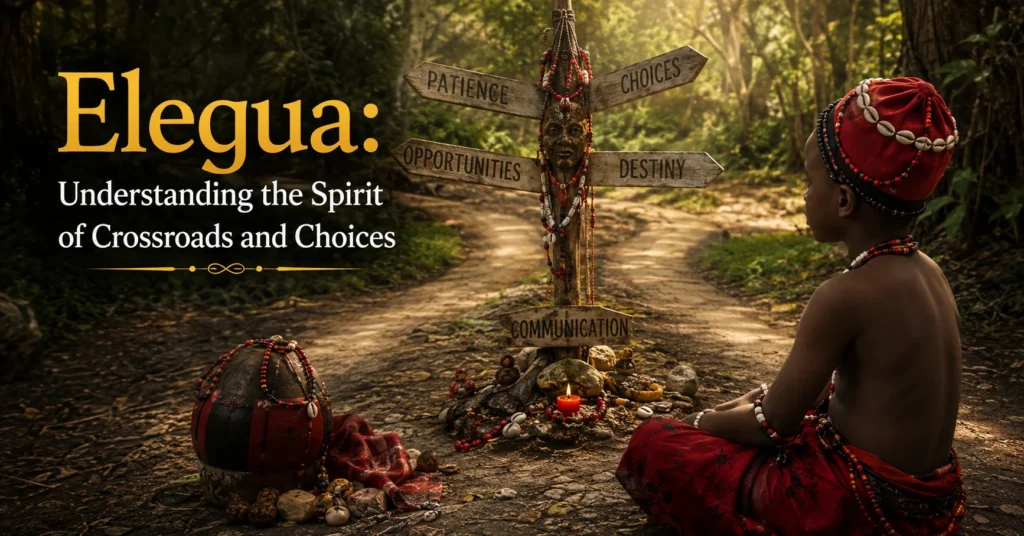
There are moments in life when everything seems to come down to a choice. You stand between two paths, unsure which direction will bring opportunity, growth, or a better future. In Yoruba and Afro-Caribbean spiritual traditions, the image of the crossroads carries deep meaning. It represents possibility, uncertainty, communication, and the decisions that shape a person’s journey.
Elegua, also known by names such as Eshu and, in Cuban Lucumí tradition, Elegguá, is closely associated with crossroads, roads, doors, communication, and the opening or closing of possibilities. He is one of the most widely recognized spiritual figures in traditions connected to Yoruba religion and its diasporic forms.
Understanding Elegua requires more than thinking of him simply as a “spirit of crossroads.” His symbolism reaches into everyday life. Roads represent movement, doors represent opportunities, and choices represent personal responsibility. Elegua’s place within these ideas makes him an important figure for understanding how spiritual traditions explore uncertainty and human decision-making.
ALSO READ: Zombie Chicken: A Strange And Spooky Mystery
Who Is Elegua?
Elegua is a prominent Orisha associated with the Yoruba spiritual tradition of West Africa and with related religious traditions throughout the African diaspora. Orishas are divine or spiritual powers connected with different aspects of existence, nature, human experience, and the relationship between people and the sacred.
Elegua is especially connected with communication, pathways, entrances, boundaries, and choices. Because communication is essential for relationships between people and between humans and the divine, his role is particularly significant.
In many traditions, Elegua is understood as being present at thresholds and crossroads. A threshold is a place where one space meets another. A crossroads is where multiple roads meet. Both images naturally represent moments of transition.
This symbolism explains why Elegua is often associated with beginnings and opportunities. Before a person can move forward, there is usually a decision to make. The road ahead may not always be obvious, and circumstances can change quickly.
It is important to recognize that traditions involving Elegua are diverse. Yoruba religion, Cuban Lucumí, Haitian Vodou, and other Afro-diasporic traditions have their own histories, practices, names, interpretations, and religious structures. They should not all be treated as identical.
The Meaning Of Crossroads
The crossroads is one of the most powerful symbols connected with Elegua.
Imagine standing at a place where four roads meet. Each road could lead somewhere different. You may know where some roads begin, but you cannot know everything that waits at the end of each one.
That uncertainty is part of the symbolism.
A crossroads can represent:
- A major life decision
- A new beginning
- A transition from one stage to another
- An unexpected opportunity
- Communication and negotiation
- The consequences of choices
- The uncertainty of the future
This makes the crossroads a powerful metaphor for ordinary human life.
People reach crossroads when choosing a career, beginning a relationship, moving to a new place, ending an old chapter, or deciding whether to take a difficult opportunity. In this sense, Elegua’s symbolism can encourage reflection on the importance of paying attention to the roads we choose.
The crossroads is not necessarily a place of confusion. It can also be a place of possibility.
Elegua And The Power Of Choice
One of the most interesting ideas associated with Elegua is the relationship between opportunity and choice.
A door can be open, but someone still has to decide whether to walk through it. A road can be available, but someone still has to choose a direction.
This symbolism provides a useful way to think about personal responsibility. Opportunities may appear unexpectedly, but how we respond to them matters.
Elegua’s connection with choices can therefore be understood as a reminder to remain aware of possibilities. Sometimes people become so focused on one expected outcome that they fail to notice another path.
The lesson is not simply to choose quickly. It is to pay attention.
A thoughtful decision requires awareness, communication, patience, and an understanding of possible consequences. These qualities fit naturally with the broader symbolism surrounding Elegua.
Elegua And Communication
Communication is another major part of Elegua’s traditional associations.
Human relationships depend on communication. Families, friendships, communities, and societies all require people to exchange information and understand one another.
When communication breaks down, opportunities can disappear and misunderstandings can grow.
This is why Elegua’s association with communication has such meaningful symbolism. Roads connect places, while communication connects people.
A message must travel from one person to another just as a traveler moves along a road. Both journeys can encounter obstacles.
In a symbolic sense, Elegua can therefore be connected with the opening of communication and the movement of information.
This also highlights why words should be used carefully. A conversation can open a door, repair a relationship, create an opportunity, or completely change the direction of a situation.
Doors Gates And Thresholds
Doors and gates are closely connected to the idea of crossroads.
A closed door can represent something unavailable, while an open door may symbolize an opportunity. Yet doors also suggest boundaries. Entering one space means leaving another.
Elegua’s connection with entrances and thresholds reflects this important idea of transition.
People experience countless symbolic thresholds throughout life. Childhood becomes adulthood. Education becomes employment. A relationship begins or ends. A person leaves one home and creates another.
These moments can feel uncertain because the familiar world exists behind us while the future remains unknown.
The symbolism associated with Elegua provides a spiritual way of thinking about these transitions. Instead of seeing uncertainty only as something frightening, a threshold can also be viewed as a place where something new becomes possible.
Why Elegua Is Associated With Open Roads
The phrase “open roads” is often used in spiritual discussions involving Elegua. Symbolically, an open road represents movement, possibility, and fewer obstacles.
However, it is useful to understand this idea carefully rather than treating it as a promise that every desired outcome will automatically happen.
Life naturally includes obstacles. An open road does not necessarily mean an easy road.
Instead, the image can represent the ability to move forward, recognize opportunities, communicate effectively, and make informed decisions.
This interpretation also avoids reducing a complex spiritual tradition to the idea of simply asking for good luck.
Elegua’s symbolism can be understood more deeply as an invitation to become attentive to the choices and circumstances surrounding us.
Elegua In Yoruba Tradition
Elegua’s roots are connected to the Yoruba religious worldview of West Africa. The Yoruba tradition has a long and complex history, with religious concepts developing across communities and changing through historical and cultural encounters.
In Yoruba contexts, Eshu is an important divine figure associated with communication, crossroads, movement, and the relationship between humans and the divine order.
Over time, Yoruba religious traditions traveled across the Atlantic through the African diaspora. Enslaved Africans carried religious knowledge, beliefs, cultural practices, languages, and traditions with them despite the devastating conditions of slavery.
These traditions later developed in different forms throughout the Caribbean and the Americas.
As a result, the names and interpretations associated with Elegua or Eshu can differ depending on the religious tradition and community being discussed.
Understanding this history is important because it prevents oversimplification.
Elegua In Afro-Caribbean Traditions
In Cuba and other parts of the Caribbean, traditions influenced by Yoruba religion developed distinctive forms. In Cuban Lucumí, Elegguá is an important Orisha associated with roads, entrances, communication, and opportunities.
Other Afro-diasporic traditions may use different names or understand related spiritual figures through different religious frameworks.
This diversity is part of the richness of African diasporic spirituality.
Rather than assuming that every representation of Elegua means exactly the same thing, it is better to consider the specific tradition, community, and historical context.
This approach also encourages respect for practitioners whose religious understanding comes from lived tradition rather than from simplified internet descriptions.
Common Symbols Associated With Elegua
Popular representations of Elegua often include imagery connected with roads, doors, keys, crossroads, and movement.
Keys are particularly easy to understand symbolically. A key can open a door, but it can also remain unused. The object represents possibility, while the person holding it still has a decision to make.
Road imagery works in a similar way.
A road suggests movement and direction. A crossroads introduces multiple possibilities. A doorway suggests transition.
Colors, objects, numbers, offerings, and other ritual details can vary significantly between traditions and should not be assumed to have one universal meaning.
This is one reason it is important to distinguish traditional religious practice from generalized spiritual content found online.
Why People Find Elegua Symbolism Meaningful
Even people who are unfamiliar with Yoruba or Afro-Caribbean religious traditions can understand why the symbolism of Elegua resonates with so many people.
Everyone faces decisions.
Everyone encounters unexpected opportunities.
Everyone experiences moments when a familiar path ends and a new one begins.
The crossroads provides a visual representation of these experiences.
It reminds us that the future is not always predictable. At the same time, it reminds us that our responses matter.
This combination of uncertainty and responsibility is one of the most powerful aspects of the symbolism.
Elegua can therefore be explored not merely as a supernatural figure, but as part of a broader spiritual understanding of movement, communication, possibility, and choice.
Elegua And Personal Reflection
The symbolism surrounding Elegua can inspire useful questions for personal reflection.
When facing a difficult decision, a person might ask:
What choices are actually available to me?
Am I overlooking an option because I am afraid of change?
Have I communicated clearly with the people involved?
What consequences might follow each path?
Am I paying attention to opportunities around me?
These questions do not require someone to adopt a particular religious belief. They simply demonstrate how the crossroads can function as a meaningful metaphor.
A crossroads encourages awareness before movement.
Sometimes the wisest choice is not the fastest one. Taking time to understand a situation can prevent a person from entering a path without considering where it might lead.
Misunderstandings About Elegua
Elegua is sometimes portrayed inaccurately in popular culture and online discussions.
One common problem is reducing him to a simple “trickster” character. While trickster imagery can appear in discussions of Eshu and related figures, reducing a complex religious figure to a mischievous character misses the broader significance of communication, balance, movement, and the relationship between choices and consequences.
Another misunderstanding is assuming that every depiction of Elegua belongs to one universal tradition.
It does not.
Different communities have distinct practices and interpretations. Some details found online may be mixed together from unrelated traditions, modern spiritual practices, or popular culture.
Approaching Elegua with historical and cultural respect allows for a much richer understanding.
The Difference Between Symbolism And Religious Practice
There is an important difference between learning about the symbolism of Elegua and practicing a religion involving Elegua.
Someone can study the meaning of crossroads, communication, and choices without claiming religious authority or performing rituals.
Religious practices belong to communities and traditions with their own rules, teachings, initiation processes, and forms of guidance.
For this reason, online articles should not present personal interpretations as universal religious instructions.
Learning is best approached with humility, especially when discussing living religious traditions with deep historical roots.
What The Crossroads Can Teach Us Today
The crossroads remains a powerful symbol because modern life is filled with decisions.
Technology gives people more choices than ever, yet having more options does not always make decisions easier.
People can become overwhelmed by career choices, relationships, financial decisions, personal goals, and changing circumstances.
The crossroads reminds us that uncertainty is a normal part of life.
Instead of demanding absolute certainty before moving forward, we can learn to make thoughtful decisions using the information available to us.
We can listen carefully.
We can communicate honestly.
We can recognize opportunities.
We can accept that some outcomes cannot be predicted.
And, perhaps most importantly, we can take responsibility for the road we choose.
How Elegua Symbolism Relates To Everyday Life
The symbolism becomes especially relatable when viewed through ordinary experiences.
A job interview may represent an unexpected road.
A difficult conversation may become a doorway to understanding.
Moving to a new city may place someone at a literal and emotional crossroads.
Starting a new project may require stepping onto a path without knowing exactly where it will end.
These experiences show why spiritual symbols continue to matter. They provide language for experiences that are difficult to explain logically.
Elegua’s associations with roads, doors, communication, and choices offer a way to think about uncertainty without pretending that life is completely predictable.
Respecting The Tradition
Anyone learning about Elegua should approach the subject respectfully.
Yoruba and Afro-diasporic religions are not simply collections of mystical symbols. They are living traditions connected to communities, histories, families, ceremonies, beliefs, and cultural identities.
It is also helpful to avoid treating sacred practices as entertainment or collecting religious symbols without understanding their meaning.
A respectful approach begins with listening and learning.
Instead of asking only, What can Elegua do for me? it can be more meaningful to ask, What does this tradition teach about communication, choices, responsibility, and the relationship between people and the sacred?
That change in perspective leads to deeper understanding.
Conclusion
Elegua is much more than a simple symbol of crossroads. Through his associations with roads, doors, communication, choices, and transitions, he represents ideas that have deep significance within Yoruba and Afro-diasporic religious traditions.
The crossroads offers a powerful image of life itself. We often arrive at moments when several paths seem possible, yet we cannot know exactly where each one will lead. What we can do is pay attention, communicate honestly, consider consequences, and make thoughtful choices.
Understanding Elegua also requires recognizing the diversity of traditions in which related beliefs appear. Yoruba religion and its diasporic expressions have complex histories that deserve respect rather than oversimplification.
Ultimately, the enduring symbolism of Elegua reminds us that crossroads are not only places of uncertainty. They can also be places of possibility. Every new road represents movement, every doorway represents transition, and every meaningful choice can change the direction of a life.
FAQs
What is Elegua?
Elegua is a spiritual figure associated with Yoruba and Afro-diasporic religious traditions. He is strongly connected with crossroads, roads, communication, entrances, choices, and opportunities.
Why is Elegua associated with crossroads?
Crossroads symbolize moments when different paths and possibilities meet. This reflects Elegua’s traditional associations with choices, movement, communication, and transitions.
Is Elegua the same as Eshu?
The relationship between Elegua and Eshu depends on the specific religious tradition being discussed. They are closely related in historical and diasporic contexts, but the names and interpretations are not universally interchangeable.
What do doors symbolize in connection with Elegua?
Doors and entrances can symbolize opportunities, transitions, boundaries, and access to new possibilities. They complement the broader symbolism of roads and crossroads.
What can people learn from Elegua’s symbolism?
Elegua’s symbolism can encourage people to pay attention to choices, communicate clearly, recognize opportunities, and think carefully about the paths they take.
ALSO READ: Southall Health And Safety: A Simple Guide

Elara Voss is a technology writer and immersive systems researcher at Argos.Vu, exploring the intersection of AI, virtual reality, and spatial computing. Her work focuses on how emerging technologies reshape the way we perceive, interact with, and understand information in the real world.
She writes about cutting-edge innovations, digital environments, and the future of human–technology interaction—translating complex ideas into engaging, forward-thinking insights.