/*
  15-462 Computer Graphics I
  Lecture 8: Shading in OpenGL
  [Angel, Ch. 6.6-6.9]

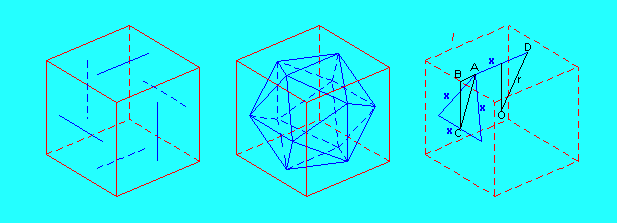
  Drawing an icosahedron
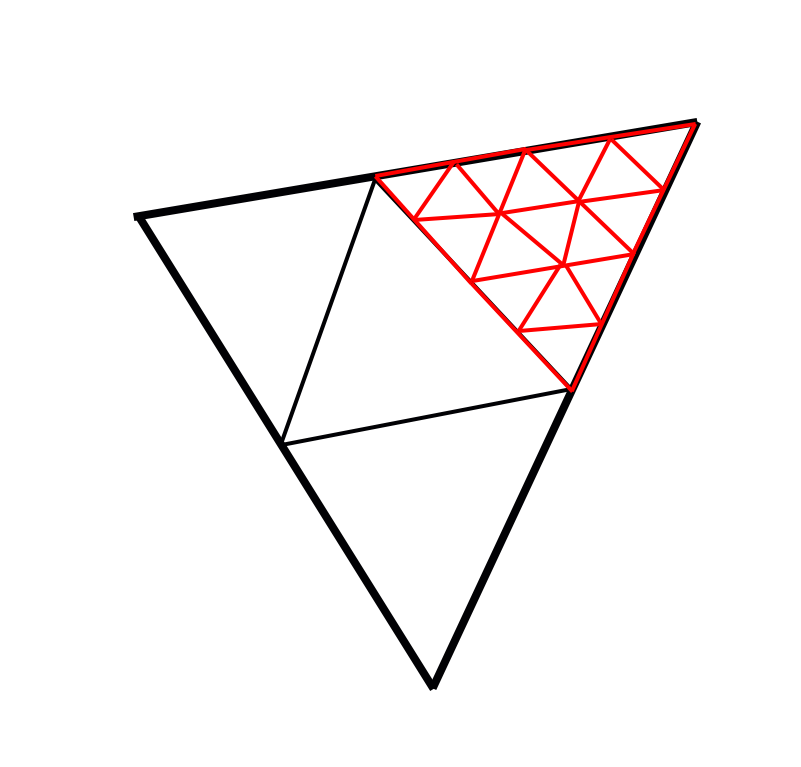
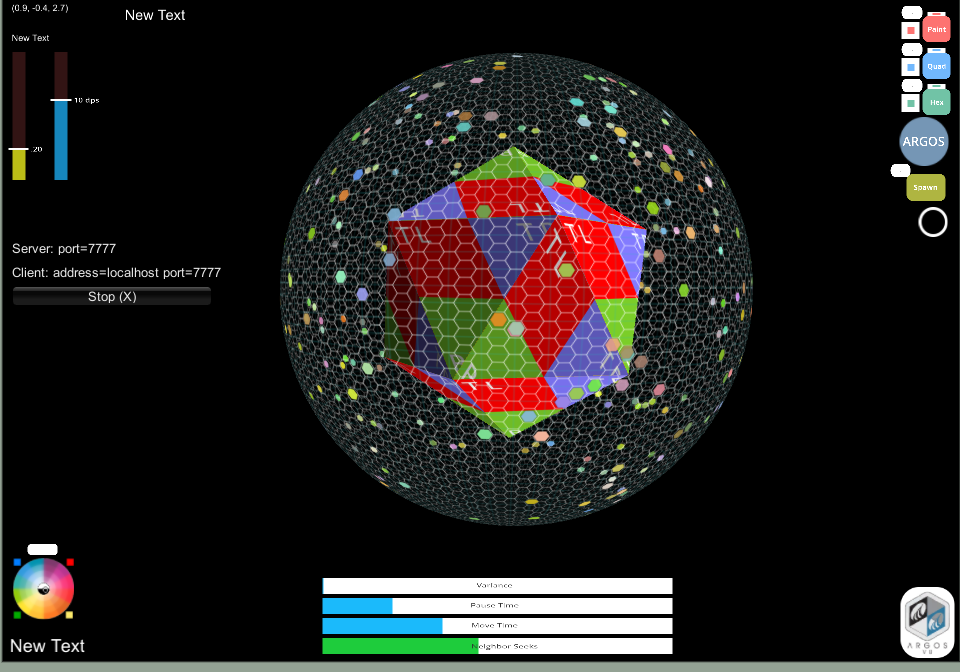
  Subdividing an icosahedron to approximate a sphere

  Based on OpenGL programming guide
  Modified: Frank Pfenning
*/

/*
  Keyboard inputs:
  +  increase subdivision depth
  -  decrease subdivision depth
  f  flat shading (regular object)
  s  smooth shading (approximate sphere)
  q  quit
*/

#include <stdlib.h>
#include <math.h>
#include <GL/glut.h>

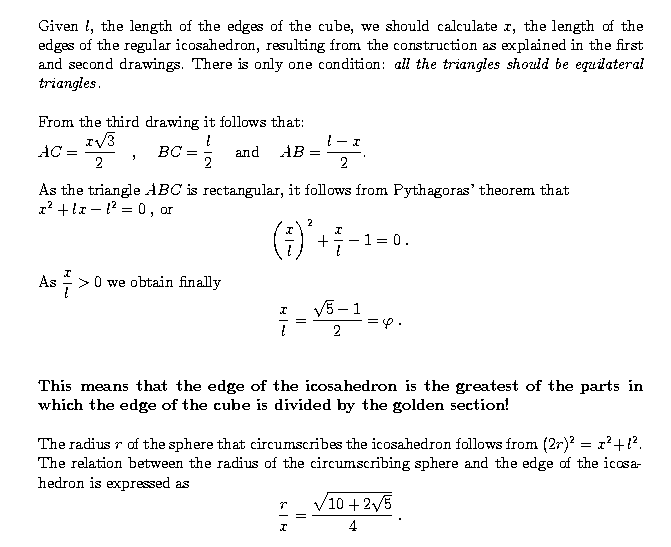
#define X 0.525731112119133696
#define Z 0.850650808352039932

/* vertex data array */
static GLfloat vdata[12][3] = {
  {-X, 0.0, Z}, {X, 0.0, Z}, {-X, 0.0, -Z}, {X, 0.0, -Z},
  {0.0, Z, X}, {0.0, Z, -X}, {0.0, -Z, X}, {0.0, -Z, -X},
  {Z, X, 0.0}, {-Z, X, 0.0}, {Z, -X, 0.0}, {-Z, -X, 0.0}
};

/* triangle indices */
static int tindices[20][3] = {
  {1,4,0}, {4,9,0}, {4,5,9}, {8,5,4}, {1,8,4},
  {1,10,8}, {10,3,8}, {8,3,5}, {3,2,5}, {3,7,2},
  {3,10,7}, {10,6,7}, {6,11,7}, {6,0,11}, {6,1,0},
  {10,1,6}, {11,0,9}, {2,11,9}, {5,2,9}, {11,2,7}
};

GLfloat mat_specular[] = {0.0, 0.0, 0.0, 1.0};
GLfloat mat_diffuse[]  = {0.8, 0.6, 0.4, 1.0};
GLfloat mat_ambient[]  = {0.8, 0.6, 0.4, 1.0};
GLfloat mat_shininess = 100.0;	/* unused if specular is 0 */

GLfloat light_ambient[]  = {0.2, 0.2, 0.2, 1.0};
GLfloat light_diffuse[]  = {1.0, 1.0, 1.0, 1.0};
GLfloat light_specular[] = {0.0, 0.0, 0.0, 1.0};

GLfloat light_position[] = {1.5, 1.0, -2.0, 0.0}; /* directional */

int flat = 1;			/* 0 = smooth shading, 1 = flat shading */
int subdiv = 0;			/* number of subdivisions */

/* normalize a vector of non-zero length */
void normalize(GLfloat v[3])
{
  GLfloat d = sqrt(v[0]*v[0] + v[1]*v[1] + v[2]*v[2]);
  /* omit explict check for division by zero */

  v[0] /= d; v[1] /= d; v[2] /= d;
}

/* normalized cross product of non-parallel vectors */
void normCrossProd (GLfloat u[3], GLfloat v[3], GLfloat n[3])
{
  n[0] = u[1]*v[2] - u[2]*v[1];
  n[1] = u[2]*v[0] - u[0]*v[2];
  n[2] = u[0]*v[1] - u[1]*v[0];
  normalize(n);
}

void normFace(GLfloat v1[3], GLfloat v2[3], GLfloat v3[3])
{
  GLfloat d1[3], d2[3], n[3];
  int k;
  for (k = 0; k < 3; k++) {
    d1[k] = v1[k] - v2[k];
    d2[k] = v2[k] - v3[k];
  }
  normCrossProd(d1, d2, n);
  glNormal3fv(n);
}

/* draw triangle using face normals */
void drawTriangleFlat(GLfloat v1[3], GLfloat v2[3], GLfloat v3[3])
{
  glBegin(GL_TRIANGLES);
    normFace(v1, v2, v3);
    glVertex3fv(v1);
    glVertex3fv(v2);
    glVertex3fv(v3);
  glEnd();
}

/* draw triangle using sphere normals */
void drawTriangleSmooth(GLfloat v1[3], GLfloat v2[3], GLfloat v3[3])
{
  glBegin(GL_TRIANGLES);
    glNormal3fv(v1);
    glVertex3fv(v1);
    glNormal3fv(v2);
    glVertex3fv(v2);
    glNormal3fv(v3);
    glVertex3fv(v3);
  glEnd();
}

/* recursively subdivide face `depth' times */
/* and draw the resulting triangles */
void subdivide(GLfloat v1[3], GLfloat v2[3], GLfloat v3[3], int depth)
{
  GLfloat v12[3], v23[3], v31[3];
  int i;

  if (depth == 0) {
    if (flat == 1)
      drawTriangleFlat(v1, v2, v3);
    else
      drawTriangleSmooth(v1, v2, v3);
    return;
  }

  /* calculate midpoints of each side */
  for (i = 0; i < 3; i++) {
    v12[i] = (v1[i]+v2[i])/2.0;
    v23[i] = (v2[i]+v3[i])/2.0;
    v31[i] = (v3[i]+v1[i])/2.0;
  }
  /* extrude midpoints to lie on unit sphere */
  normalize(v12);
  normalize(v23);
  normalize(v31);

  /* recursively subdivide new triangles */
  subdivide(v1, v12, v31, depth-1);
  subdivide(v2, v23, v12, depth-1);
  subdivide(v3, v31, v23, depth-1);
  subdivide(v12, v23, v31, depth-1);
}

void display(void)
{
  int i;

  glClear(GL_COLOR_BUFFER_BIT | GL_DEPTH_BUFFER_BIT);

  glMatrixMode(GL_MODELVIEW);
  glLoadIdentity();
  gluLookAt(0.5, 0.5, -1.5, /* eye */
            0.0, 0.0, 0.0,  /* at */
	    0.0, 1.0, 0.0); /* up */
  glLightfv(GL_LIGHT0, GL_POSITION, light_position);

  /* drawIco(); */
  /* drawSphere(); */
  for (i = 0; i < 20; i++) {
    subdivide(&vdata[tindices[i][0]][0],
              &vdata[tindices[i][1]][0],
	      &vdata[tindices[i][2]][0],
	      subdiv);
  }

  glFlush();
}

void reshape(int w, int h)
{
  GLfloat aspect = (GLfloat) w / (GLfloat) h;
  glViewport(0, 0, w, h);

  glMatrixMode(GL_PROJECTION);
  glLoadIdentity();
  if (w <= h)
    glOrtho(-1.25, 1.25, -1.25 * aspect, 1.25 * aspect, -2.0, 2.0);
  else
    glOrtho(-1.25 * aspect, 1.25 * aspect, -1.25, 1.25, -2.0, 2.0);
  glMatrixMode(GL_MODELVIEW);

  glutPostRedisplay();
}

void init()
{
  glClearColor(0.0, 0.0, 0.0, 0.0);

  glLightfv(GL_LIGHT0, GL_AMBIENT, light_ambient);
  glLightfv(GL_LIGHT0, GL_DIFFUSE, light_diffuse);
  glLightfv(GL_LIGHT0, GL_SPECULAR, light_specular);

  glMaterialfv(GL_FRONT, GL_SPECULAR, mat_specular);
  glMaterialfv(GL_FRONT, GL_AMBIENT, mat_ambient);
  glMaterialfv(GL_FRONT, GL_DIFFUSE, mat_diffuse);
  glMaterialf(GL_LIGHT0, GL_SHININESS, mat_shininess);

  glShadeModel(GL_SMOOTH);	/* enable smooth shading */
  glEnable(GL_LIGHTING);	/* enable lighting */
  glEnable(GL_LIGHT0);		/* enable light 0 */

  glEnable(GL_DEPTH_TEST);
}

void keyboard(unsigned char key, int x, int y)
{
  if (key=='q') exit(0);
  if (key=='+') subdiv++;
  if (key=='-') subdiv--;
  if (key=='f') flat = 1;
  if (key=='s') flat = 0;

  if (subdiv<0) subdiv = 0;

  glutPostRedisplay();
}

int main(int argc, char **argv)
{
  /* create window */
  glutInit(&argc, argv);
  glutInitDisplayMode(GLUT_RGB | GLUT_DEPTH); /* single buffering */
  glutInitWindowSize(500, 500);
  glutCreateWindow("Subdivide");

  /* set callbacks */
  glutReshapeFunc(reshape);
  glutDisplayFunc(display);
  glutKeyboardFunc(keyboard);

  /* initialize GL */
  init();

  glutMainLoop();
  return(0);
}
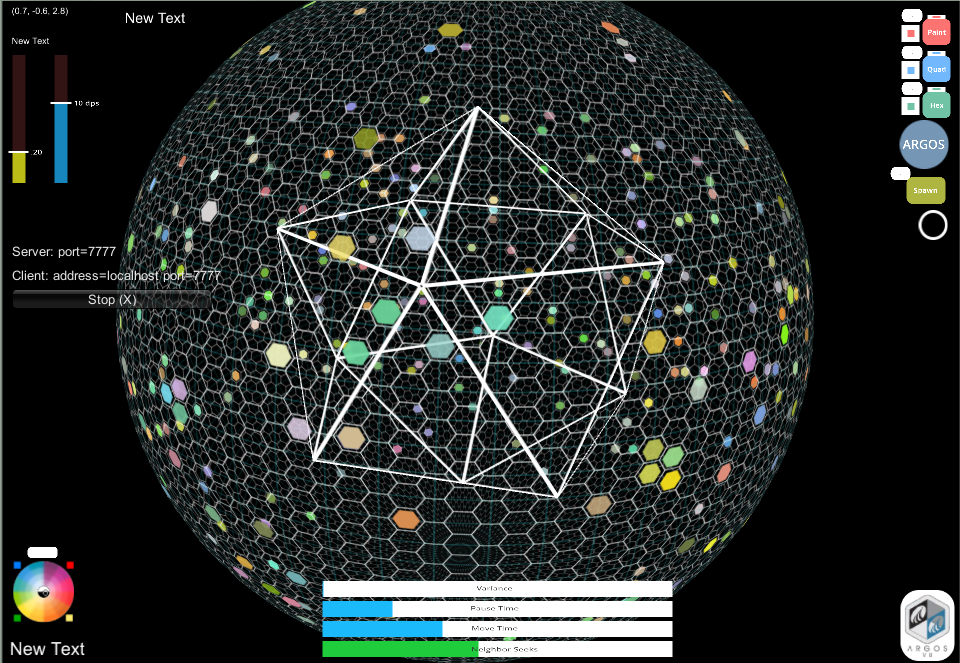
Handle Argos_Sphere Rotation r(t) for tweened quaternions